
Comparison of IEC and UL Standards for EV Charging Leakage Protection
Pulished on Apr. 10, 2026
Both the IEC (International Electrotechnical Commission) and UL (Underwriters Laboratories) prioritize personal safety in EV charging leakage current protection, but their implementation paths differ: IEC focuses on the coordination of residual current devices (RCDs) for both AC and DC components, requiring more detailed fault type detection; UL emphasizes closed-loop detection of the charging circuit interrupter (CCID), stressing the ability to interrupt fault current quickly, and its standards are primarily compatible with NEC.
1. Core Differences
Technical Standards:
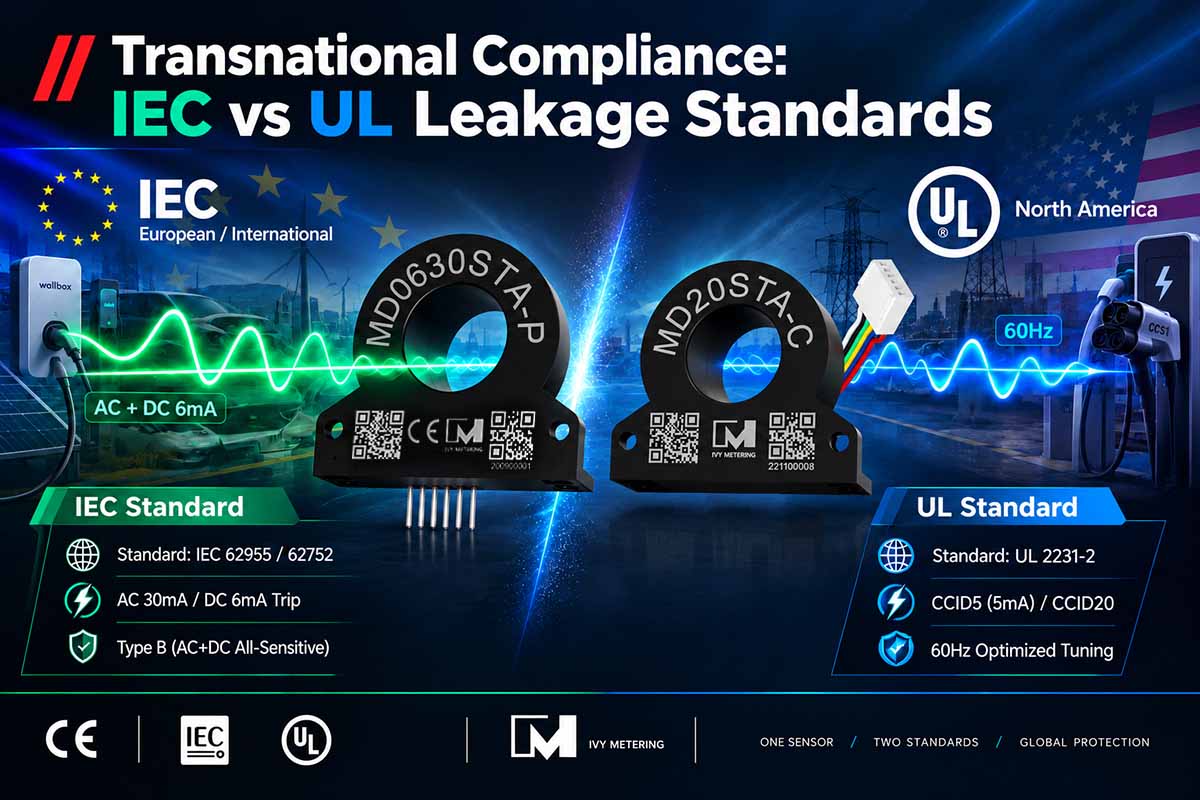
IEC: Primarily defines leakage current through IEC 61851-1 (system standard), IEC 62752 (IC-CPD), and IEC 62955 (residual current monitoring devices).
UL: Certifies based on UL 2231-1/2 (personnel protection in charging systems) and UL 2594 (electric vehicle power supply equipment).
Leakage Current Detection Range:
IEC: Particularly emphasizes the detection of composite leakage currents (AC/DC superposition), such as 6mA DC and 30mA AC. The system needs to be able to simultaneously identify AC, Type A, or Type B RCDs.
UL: Focuses on CCID, typically categorized as CCID 20 (20mA), primarily detecting ground fault current, including ground fault detection and automatic closure detection.
Detection Frequency:
IEC: Test equipment must be able to detect frequencies up to 1MHz, which exceeds UL standards for sensitive equipment protection.
Applicable Regions:
IEC: Primarily used in China and Europe.
UL: Primarily used in North America.
2. Comparison Summary Table
| Characteristic | IEC Standards (International/European/Chinese) | UL Standards (North America) |
| Personal protective equipment | RCD (Residual Current Device) / RDC-DD | CCID (Charging Circuit Interruption Device) |
| DC leakage protection | 6mA (e.g., according to IEC 62955) | AC/DC are both included in CCID detection. |
| AC leakage protection | 30mA (normal) | 20mA (CCID 20) |
| Technical Implementation | Subdivided into types such as AC, A, B, F, and B+. | Ground fault detection is employed, with an emphasis on rapid interruption. |
| Security Concerns | Compatibility and detection of multiple fault types | Ground monitoring |
Although standards are gradually converging, exported equipment must still meet local standards. IEC standards detect leakage current with complex circuitry to detect different waveforms, while UL standards focus more on the instantaneous disconnection after a ground fault.