
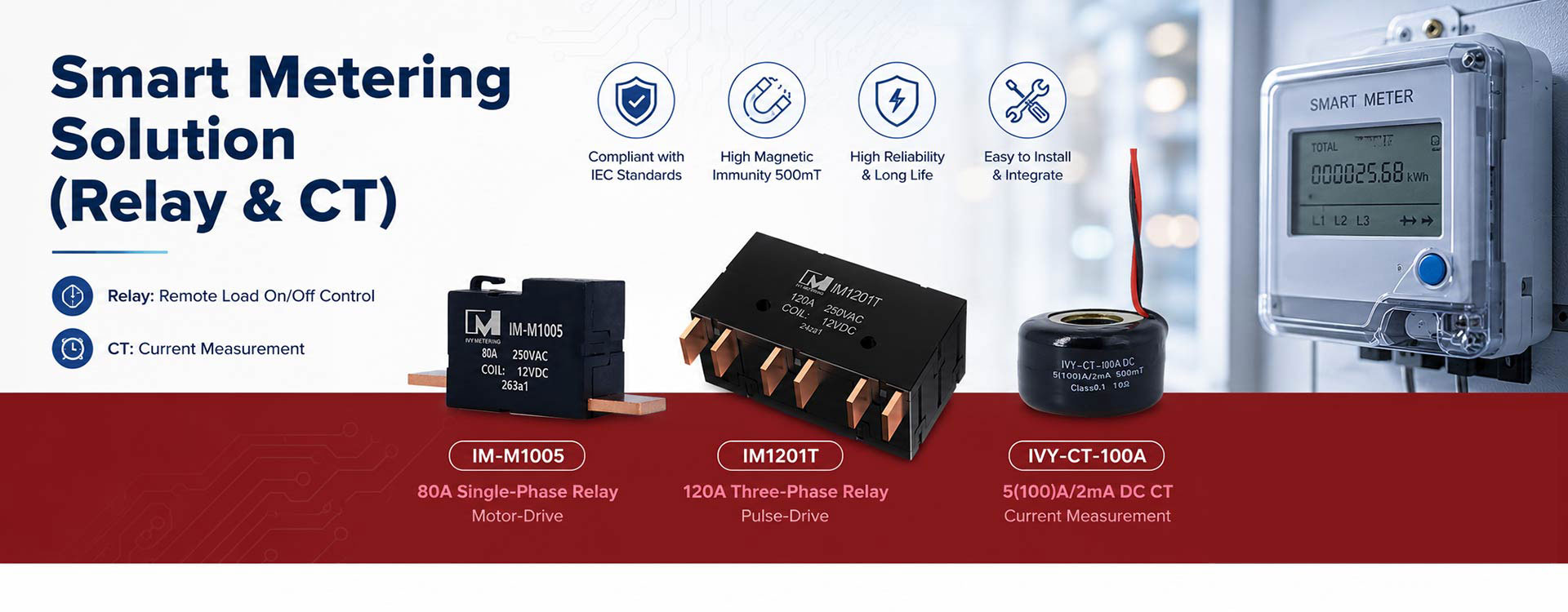
Smart Meter Relays & Latching Bistable Relays: The Core Switching Components for Smart Grids
A key component in ensuring the proper functioning of these systems is the “Latching Relay". This vital device enables precise control of the smart meter's operations, managing everything from customer demand to energy connection control. (remote load disconnect & reconnect)
In Advanced Metering Infrastructure (AMI) and smart grid developments, the smart meter relay is crucial for reliable load management. The most widely adopted technology is the latching relay (also known as a magnetic latching relay or bistable relay). Unlike standard relays, a latching relay is highly energy-efficient; it maintains its contact state without continuous power and requires only a short electrical pulse to switch.
IVY Metering latching relays are fully compliant with IEC 62055-31 or IEC 62052-11, UC2/UC3 standards. Available in both traditional pulse-driven and advanced motor-driven designs, they feature high current capacities (up to 150A) and exceptional magnetic immunity (up to 500mT) to prevent electricity theft. Widely applied in prepaid smart meters, EV chargers, solar PV systems, and industrial automation, our relays deliver secure, anti-tamper, and long-lasting load control solutions.
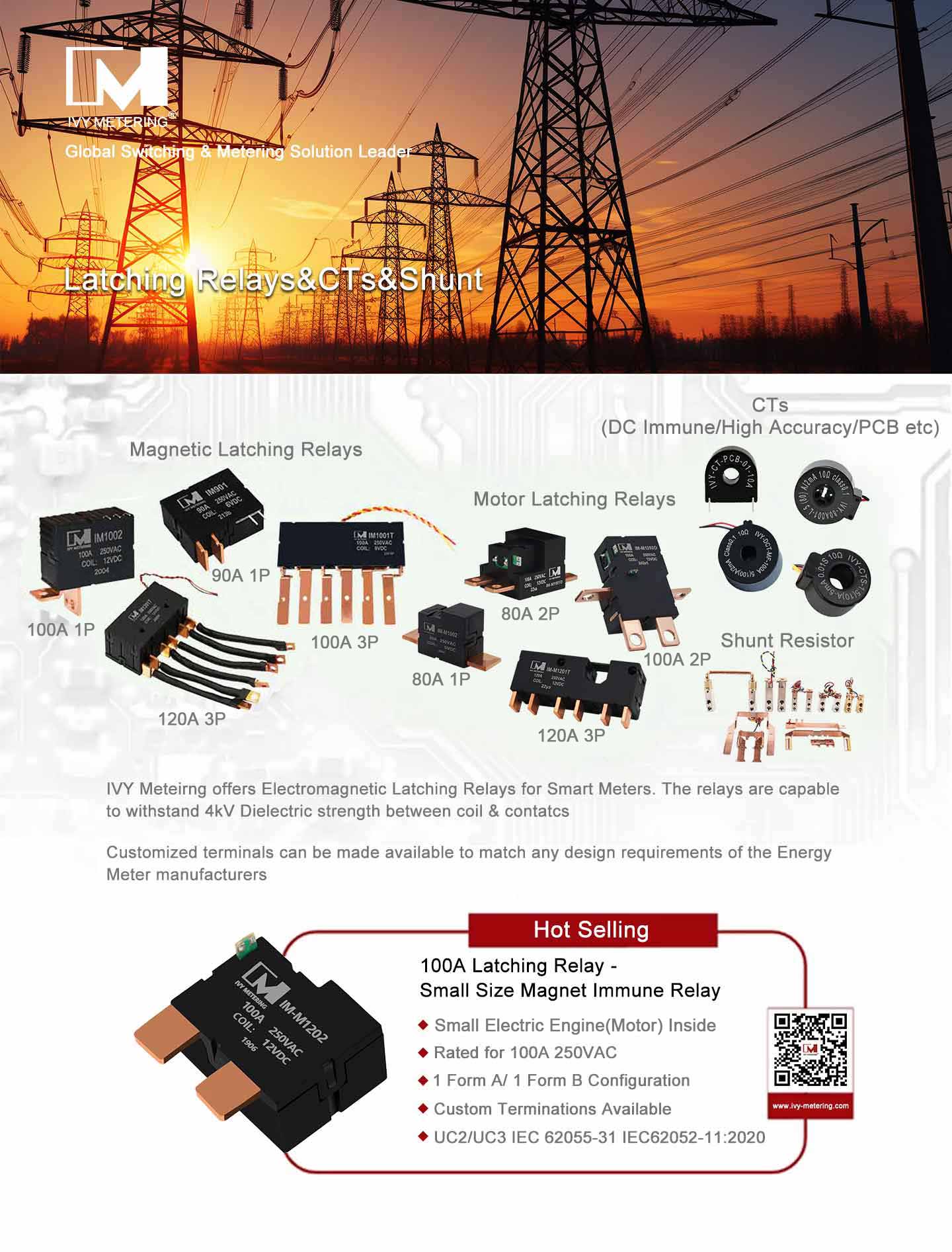
Current transformers (CTs) play a crucial role in smart meters by proportionally converting large currents into smaller ones, solving the problem of meters being unable to directly measure high-load, high-current industrial or commercial scenarios (such as hundreds to thousands of amperes). They reduce large currents to a signal that the metering chip can process at a fixed ratio (e.g., 5A or 1A standard), ensuring high-precision measurement and secure transmission of electricity data.
IVY Metering current transformers include: internal small current transformers(1~140A PCB & Lead wire type DC/Non-DC immunity high accuracy CTs) and outdoor split core current transformers (60/150/200A/400/500/800A......5000A), with mA/1A/5A output.
Application details and functions in smart meters:
High-precision measurement: As an electrical sensor, the CT reduces the amplitude of large currents, allowing the sampling chip within the smart meter to accurately capture current fluctuations and thus provide precise measurement.
Safe isolation of large currents: In scenarios with high electricity consumption, such as industrial applications and distribution cabinets, the current transformer converts the large current on the primary side (circuit) into a smaller current on the secondary side, protecting the meter circuit from burnout.
Adaptability to various complex applications: Smart meters utilize miniature current transformers for real-time monitoring without interrupting the power supply, and are widely used in electricity meters, photovoltaic grid connection, and energy monitoring.