
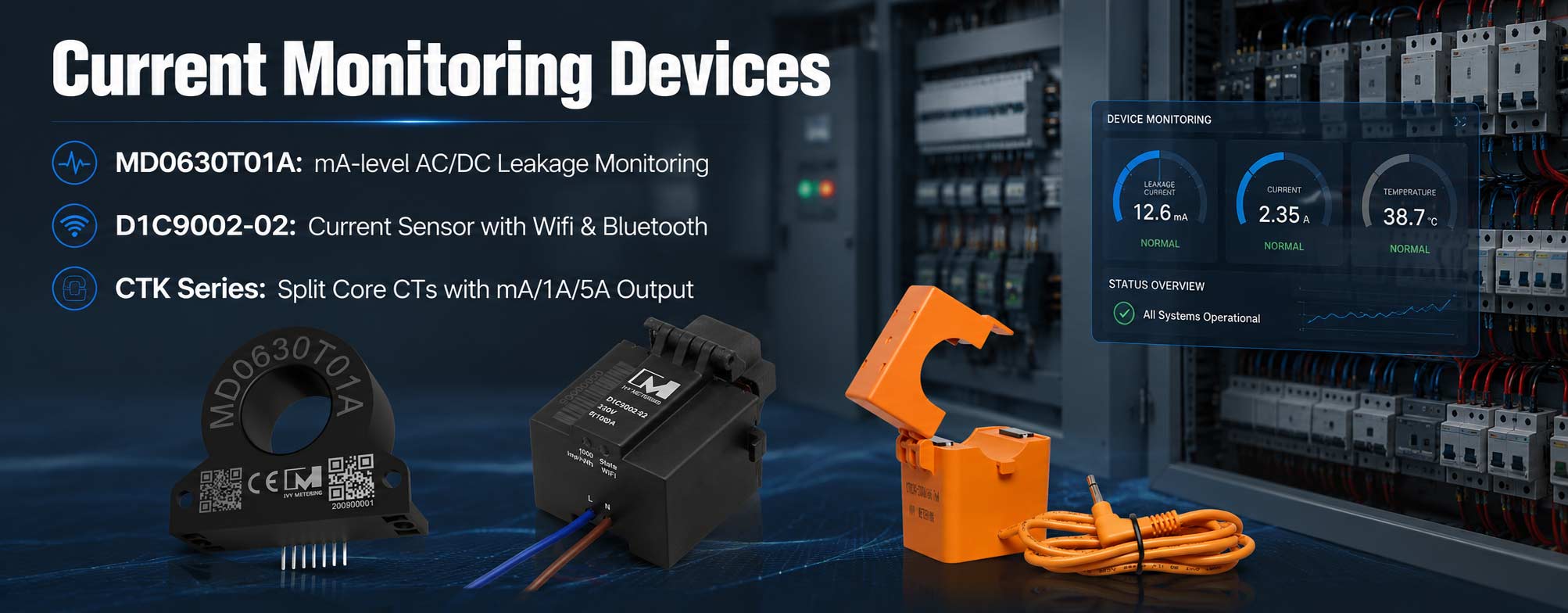
Next-Generation Wireless Current Sensors for Smart Energy Monitoring
Eliminate the high costs and downtime associated with traditional wired sub-metering. Our advanced wireless current sensors provide a plug-and-play solution for real-time energy monitoring in industrial, commercial, and residential applications.
Featuring a non-intrusive split-core design, our Wi-Fi clamp CTs (Current Sensors) can be simply snapped around live cables. Unlike standard analog transformers, a clamp current sensor with Wi-Fi acts as an all-in-one IoT terminal—measuring, processing, and transmitting highly accurate data directly to your cloud platform or local EMS via Modbus-RTU/TCP and MQTT.
Whether you are retrofitting legacy factory equipment, managing multi-site chain stores, or integrating with solar and energy storage systems, our wireless current transformers deliver millisecond-level accuracy with zero wiring hassle.
Explore our range below to achieve instant digitization and smarter energy management.
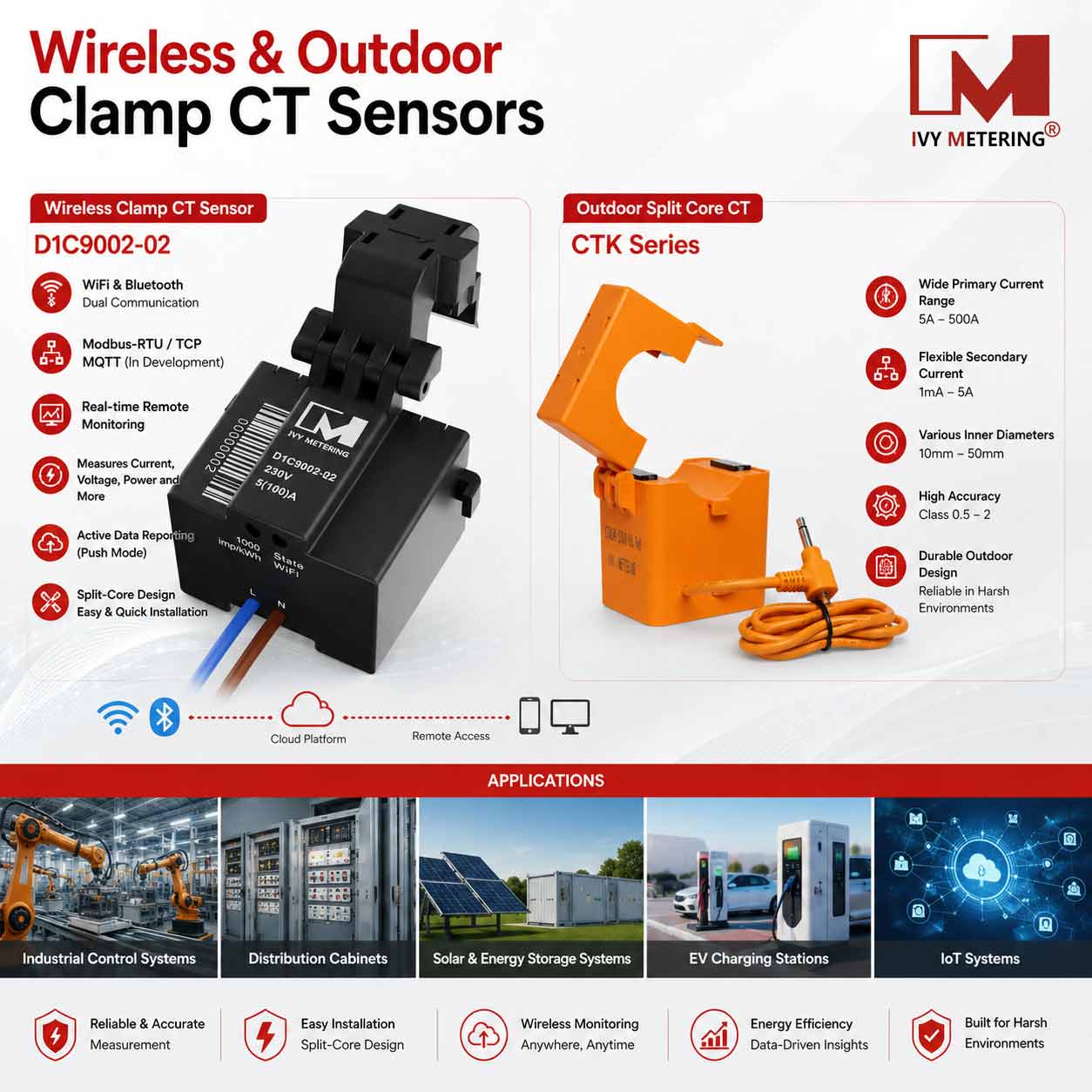
Wireless CT Current Sensor with Wifi/Bluetooth
Communication: Uses WiFi to wirelessly transmit data over a local network to the internet or cloud platform. Connection: Wireless connection, no wiring required, flexible and convenient installation.
Application Scenarios: Suitable for smart home devices, energy monitoring, remote diagnostics of industrial equipment, and other applications requiring real-time data access via a network.
Data: Provides near real-time data accessible from any location via network-connected devices.
Split Core AC Current Sensor with M-bus
Communication: Uses the M-Bus (Meter Bus) protocol, a two-wire serial communication bus typically used for utility metering.
Connection: Wired connection, providing a stable and reliable connection, less susceptible to interference.
Applications: Commonly used in electricity meters, smart grids, and industrial monitoring systems, which generally employ wired master-slave networks.
Data: Transmits data digitally, typically supporting functions such as overcurrent alarms, which can be set and triggered via the bus.
As the world adopts renewable energy sources, the need for accurate and reliable current sensing is growing. From residual current sensors to wireless CT clamp, we help engineers design fast, accurate, and safe components.