

How do I choose a latching relay for a smart meter?
[Quick Answer / TL;DR]
To choose the right latching relay for a smart energy meter, you must evaluate five critical factors:
1. Continuous Current Capacity (typically 80A, 100A, or 120A).
2. Short-Circuit Withstand Capability (Ensuring compliance with IEC 62055-31 UC2/UC3 standards to prevent contact welding).
3. Magnetic Immunity (Resistance to 500mT external magnets to prevent energy theft).
4. Ultra-Low Contact Resistance (To prevent PCB overheating during high loads).
5. Form Factor & Customization (Ensuring drop-in PCB compatibility).
The latching relay (also known as a disconnect relay) is the beating heart of a modern smart prepaid meter. It executes the critical function of remotely connecting or disconnecting power based on payment status, grid load, or safety protocols.
Unlike standard relays, a latching relay uses a brief electrical pulse to switch states and consumes zero power while resting, making it highly energy-efficient and eliminating heat generated by the coil. However, with evolving grid regulations and the increasing risk of electricity tampering, selecting the right relay is more complex than just matching the current rating. If you are an electrical engineer or smart meter OEM, here is the ultimate guide to selecting the perfect latching relay.
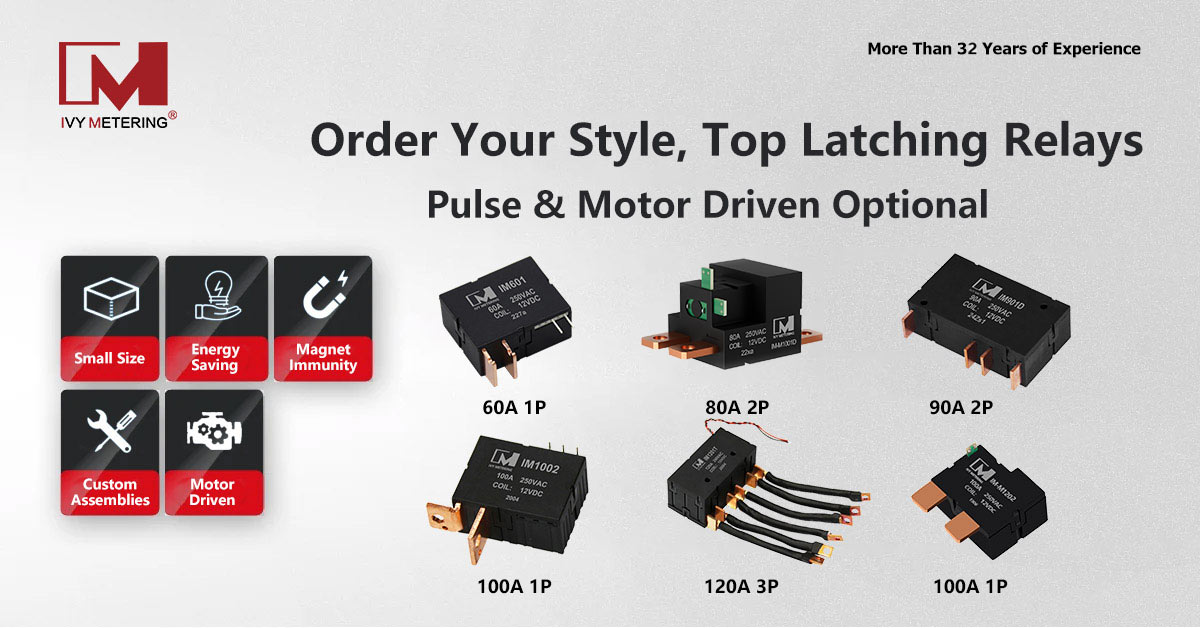
5 Critical Factors for Smart Meter Relay Selection
1. Match the Load: Current Capacity & Contact Resistance
Current Rating: Ensure the relay matches your meter's maximum continuous load. 80A, 100A, and 120A are the global standards for single-phase meters.
Contact Resistance: This is crucial. If the contact resistance is high (e.g., >1.5mΩ), passing 100A through it will generate immense heat, potentially melting the meter's casing or destroying the PCBA.
2. Conquer the Surge: Short-Circuit Withstand (UC2/UC3/UC4 Compliance)
Grid faults happen. When a massive short-circuit surge (e.g., 3000A to 4500A) hits the grid, the immense heat can melt the relay's silver contacts, welding them shut. If contacts weld, the meter can no longer disconnect power, leading to utility revenue loss and severe fire hazards.
The IEC Standard: Look for the IEC 62055-31/IEC 62052-11 standard.
The Selection: Do not settle for UC1. For high-end export meters (especially in Europe), you must choose a relay that passes UC3 or UC4 tests, meaning it can mechanically break free even if slight welding occurs during a short-circuit.
3. Stop Energy Theft: Anti-Tampering & Magnetic Immunity
In many regions (such as Latin America, the Middle East, and Asia), energy thieves place powerful neodymium magnets (up to 500mT) on the outside of the smart meter. This external magnetic field can confuse a standard magnetic latching relay, forcing it to close and allowing free electricity to flow.
The Solution: For areas with high tampering risks, opt for Motor-Driven Latching Relays. These relays use a mechanical gear system to lock the contacts in place. Because the locking mechanism is purely physical, it provides 100% immunity to external magnetic fields.
4. Optimize the Drive Type: Magnetic vs. Motor
Magnetic Latching Relays: Cost-effective, reliable, and driven by a standard pulse. Perfect for standard residential meters.
Motor Latching Relays: Driven by a micro-motor. They offer massive mechanical force to tear apart welded contacts (passing UC3 easily) and provide total magnetic immunity. Ideal for premium, high-security smart grid projects.
5. Footprint and Customization
Redesigning a smart meter's PCB to fit a new relay is expensive and time-consuming. You need a relay with standard pin layouts (drop-in replacements) or a manufacturer capable of customizing the terminals (e.g., adding integrated shunts, specific braided copper wires, or custom pin lengths) to fit your exact mechanical constraints.
IVY Metering: Your Ultimate Relay Manufacturing Partner
At IVY Metering, we are not just a supplier—we are an Integrated Manufacturer and Trading Company. This unique structure allows us to offer direct-from-factory pricing without sacrificing the professional, English-speaking technical support and logistics expertise required for international trade.
Why Leading Smart Meter Brands Choose IVY:
1. Deep OEM & Customization Capabilities: We don't just sell off-the-shelf parts. We offer deep customization. Need a relay pre-welded with a specific manganin shunt? Need custom terminal bending or unique wire lengths? Our R&D team works as an extension of your engineering department to build exactly what you need.
2. High-End Product Matrix: We manufacture everything from standard 80A magnetic latching relays to advanced UC3-compliant 120A Motor Latching Relays designed for the toughest European and Middle Eastern anti-tampering standards.
3. Guaranteed Quality: Every relay is rigorously tested for contact resistance, mechanical endurance, and thermal performance before it leaves our factory floor.
Whether you are designing a budget-friendly prepaid meter for emerging markets or a high-security smart meter for the European grid, IVY Metering provides the core components that guarantee performance, compliance, and profitability.
[Contact IVY Metering Today]
Consult with our engineers, request a sample, and let us customize the perfect latching relay solution for your next smart meter project.