

FAQ 2. Why use a motor-driven relay in a smart electricity meter?
Answer: Smart meters on modern grids face extreme conditions. Motor relays are used because they provide immense mechanical torque. If a massive short-circuit surge hits the meter and causes the electrical contacts to slightly melt and weld together, the motor's gear system generates enough brute force to tear the welded contacts apart. This allows the smart meter to easily pass the strictest IEC 62055-31 UC2/UC3 short-circuit standards, preventing fires and ensuring grid safety.
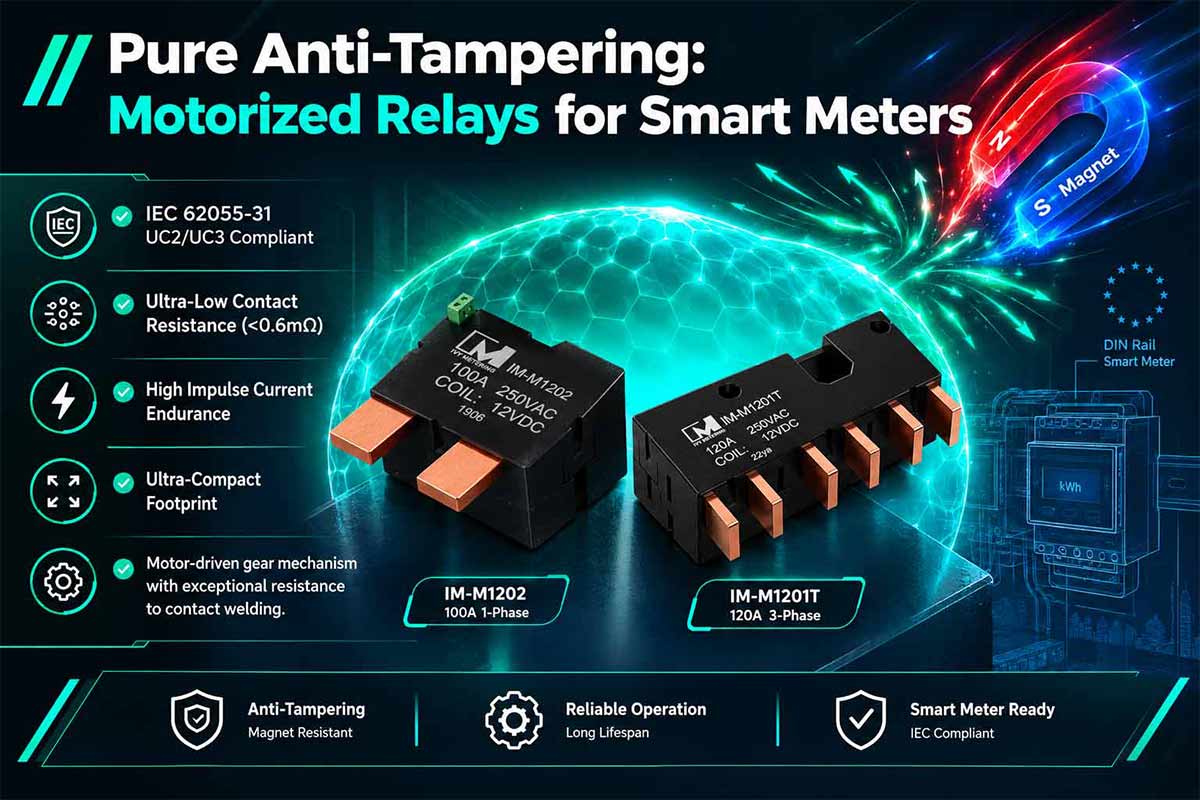
Energy thieves often place powerful neodymium magnets (generating fields up to 500mT) on the outside of a smart meter. This intense magnetic field can overpower the internal magnets of traditional latching relays, forcing them to close and allowing unmetered electricity to flow.
A relay with 500mT magnetic immunity—typically utilizing a motor-driven mechanical locking system instead of pure magnetic pull—is completely unaffected by external magnetic fields. It serves as the ultimate anti-tampering defense.
Answer: When integrating a motor relay into your hardware design, consider these 4 key factors:
Short-Circuit Compliance: Ensure it guarantees compliance with your target market's grid standards (e.g., UC3).
Current Rating & Temp Rise: Choose the right capacity (80A, 100A, or 120A) and check for ultra-low contact resistance (usually <0.6mΩ) to prevent the PCBA from overheating.
Footprint & Pins: Ensure the physical dimensions and pin layout are compatible with your existing PCB to avoid costly redesigns.
Drive Circuit Requirements: Unlike magnetic relays that just need a simple pulse, motor relays require an H-bridge drive circuit to control the motor's forward and reverse rotation.
The motor latching relay is absolutely superior.
Answer: Traditional magnetic latching relays rely on an internal permanent magnet to hold their state. Energy thieves can place a powerful external magnet (like a 400mT neodymium magnet) on the outside of the smart meter to override the internal magnet, forcing the relay to close and stealing electricity.
Because a motor latching relay relies purely on a mechanical gear lock, external magnetic fields cannot alter its physical state. It offers 100% magnetic immunity (even up to 500mT), making it the ultimate anti-tampering solution for utility companies.
IVY Metering Matrix & Application Specifics
| Product Mode | Rated Current | Contact Arrangement | Certified Compliant | Typical Application |
| IM-M801D | 60A | 2A/2B | IEC 62055-31 IEC 62052-11:2020 UC2/UC3 | Russian & CIS Residential DIN-Rail Smart Meters European Multi-tariff Smart Meters Heavy-Duty Commercial Metering & ESS Main Circuit |
| IM-M1005 New Product | 80A | 1A/1B | ||
| IM-M1001D Hot Selling | 80A | 2A/2B | ||
| IM-M1202 Hot Selling | 100A | 1A/1B | ||
| IM-M1202D | 100A | 2A/2B | ||
| IM-M1201 | 120A | 1A/1B | ||
| IM-M1201T Hot Selling | 120A | 3A/3B |
Answer: Selecting the right disconnect relay is critical for passing grid certifications and ensuring the 15-year lifespan of a smart meter. If you are designing meters for regions with high energy theft, IVY Metering's premium motor latching relays offer 100% mechanical self-locking, guaranteeing flawless 500mT magnetic immunity.