

How to Select a Current Sensor: Wireless Wi-Fi vs Wired M-Bus
What is a Current Sensor?
A current sensor is a crucial electrical device that detects AC or DC electric current flowing through a wire and generates a proportional measurable signal. This output signal can then be used to display the measured current, store the data for energy management, or trigger control actions in a larger system.
In today's era of smart grids and Industrial IoT (IoT), current sensors are no longer just passive components. The biggest challenge engineers face is choosing the right communication method and installation type. Should you go for a modern wireless IoT solution, or stick to a highly stable wired industrial protocol?
To answer this, let's compare two leading technologies using our flagship models: the Clamp-type Wireless WiFi Current Sensor (D1C9002-02) and the Wired M-Bus Current Sensor (D129072).
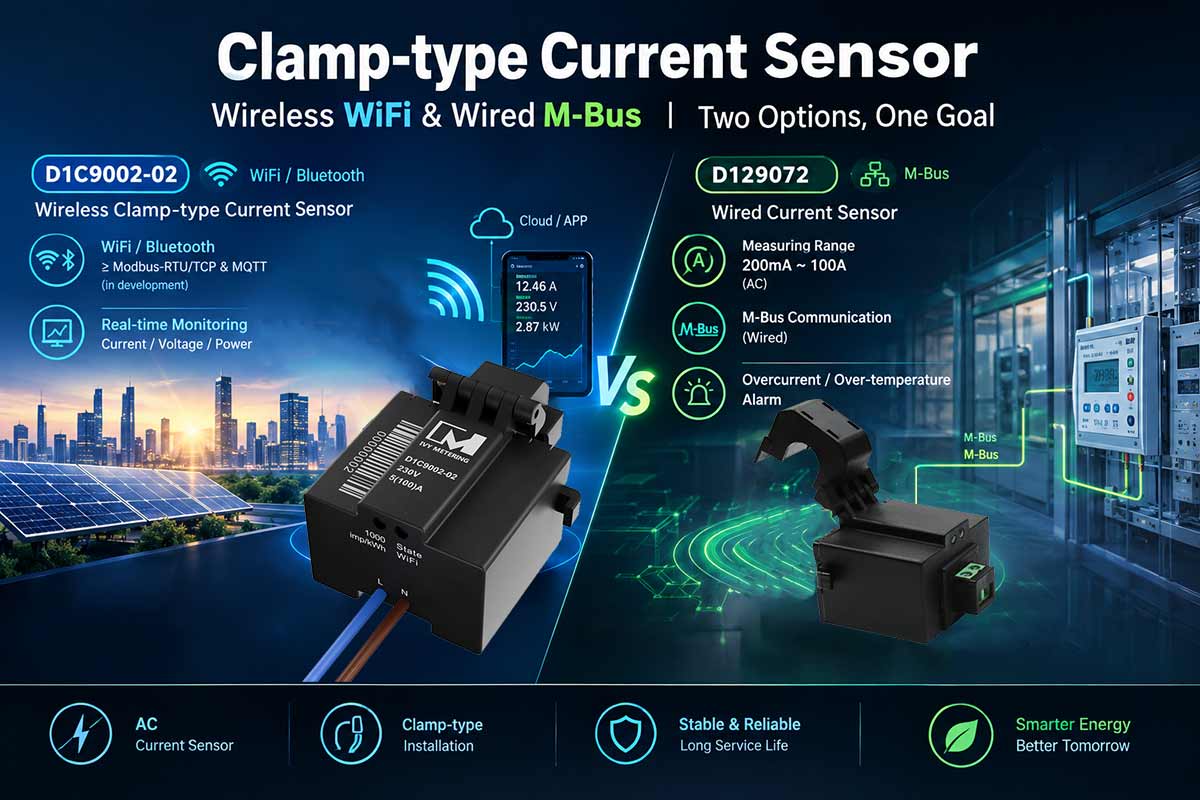
What is the difference between WiFi sensors and M-Bus sensors?
| Comparison | WiFi Current Sensor | M-Bus Current Sensor |
| Measuring parameters | Current, voltage, power, frequency | Current |
| Communication medium | Wireless communication (2.4GHz Wi-Fi) with Bluetooth (BLE) | Wired twisted-pair (M-Bus) with a simple topology. |
| Power supply method | Requires an additional power supply (External AC/DC power supply, or built-in induction power through CT cable). | Bus-powered; data transmission and power delivery share the same two lines. |
| Protocol Integration | Cloud/lightweight protocols: MQTT, HTTP, or Modbus-RTU/TCP. | Standard Metering Protocol: Standard EN 13757 (M-Bus) |
Typical application scenarios | • Rapid energy-efficiency retrofitting for commercial buildings • Smart home and lightweight device remote monitoring • Direct cloud upload of power consumption data from distributed devices | • Centralized electricity metering for residential complexes and apartments • High-density current monitoring for factory power distribution panels and cabinets • Harsh industrial environments with electromagnetic interference |
1. The Wireless Approach: Wi-Fi Clamp-Type Current Sensor (Model: D1C9002-02)
The D1C9002-02 represents the future of non-intrusive energy monitoring. It combines a split-core current transformer (CT) with a built-in Wi-Fi communication module.
How it works: Featuring a clamp-on (split-core) design, it can be snapped directly around a live cable. It measures the current, processes the data internally, and transmits it directly to a local server or cloud platform via Wi-Fi.
Key Advantages:
Wireless transmission: Supports WiFi/Bluetooth communication, convenient data transmission, and no wiring required.
Real-time Remote Monitoring: Current/voltage/power/frequency data can be viewed anytime, anywhere via the network.
Data Reporting: Data can be reported to the cloud platform via Modbus and other protocols
Bidirectional Measurement: Measures forward and reverse current and power.
2. The Wired Approach: M-Bus Current Sensor (Model: D129072)
The D129072 is a robust, wired solution utilizing the M-Bus (Meter-Bus) European standard protocol. It is engineered specifically for harsh industrial environments and dense meter reading.
How it works: It measures the current and transmits the data over a physical M-Bus two-wire cable back to a centralized data logger or PLC.
Key Advantages:
Split core allows you to directly monitor AC-current without breaking or interrupting supply.
Over-current/over-temperature protection, current value can be read without secondary transformation ratio
With M-BUS communication
Side-by-Side Comparison: How to Make the Right Choice?
Choose the Wi-Fi D1C9002-02 if you want to add smart energy monitoring to an existing facility quickly, without interrupting operations or paying high electrician labor fees.
Choose the Wired M-Bus D129072 if you are designing a new control cabinet, or working in a heavy industrial environment where wireless signals are blocked or unstable.
Conclusion
Selecting a current sensor is no longer just about measuring amps; it’s about choosing the right data transmission architecture for your project. Whether you need the rapid, cable-free deployment of the D1C9002-02 (Wi-Fi) or the rock-solid, industrial-grade reliability of the D129072 (M-Bus), we have the precise components to empower your energy management system.