

OEM Integrated EVSE Components: RCD Module VS RDC-DD
With the surging global adoption of electric vehicles (EVs), the market for AC wallboxes is experiencing explosive growth. However, for charging station manufacturers (OEMs) aiming to export their products, ensuring electrical safety compliance—specifically regarding the selection of residual current protection—often proves to be the most challenging aspect of R&D, where pitfalls are common. When an EV's onboard charger (OBC) experiences an insulation fault, smooth DC leakage current can feed back into the AC grid. This not only poses a threat to personal safety but can also cause conventional Type A residual current devices (RCDs) in the upstream grid to suffer from "magnetization-induced blinding," rendering them completely ineffective.
To address this issue, the International Electrotechnical Commission (IEC) and relevant European standards have established stringent protection requirements. Yet, during the actual R&D and component selection process, engineers often face a critical choice: should they integrate a full RCD module (such as Type B) onto the charging station's mainboard, or utilize an RDC-DD device specifically designed for EV applications?
I. What are RCDs and RDC-DDs?
1. RCD Module (Residual Current Device)
An RCD is a traditional "residual current protection device." In the context of EV charging, this typically refers to a Type B RCD.
Capabilities: It is an "all-rounder." It can detect not only AC and pulsating DC but also smooth DC leakage currents up to 30mA.
Structural Characteristics: Traditional RCDs are usually standalone, relatively bulky DIN-rail mounted devices that integrate both the detection sensor and the mechanical tripping/disconnection mechanism.
Standards: IEC 61008-1 / IEC 62423.
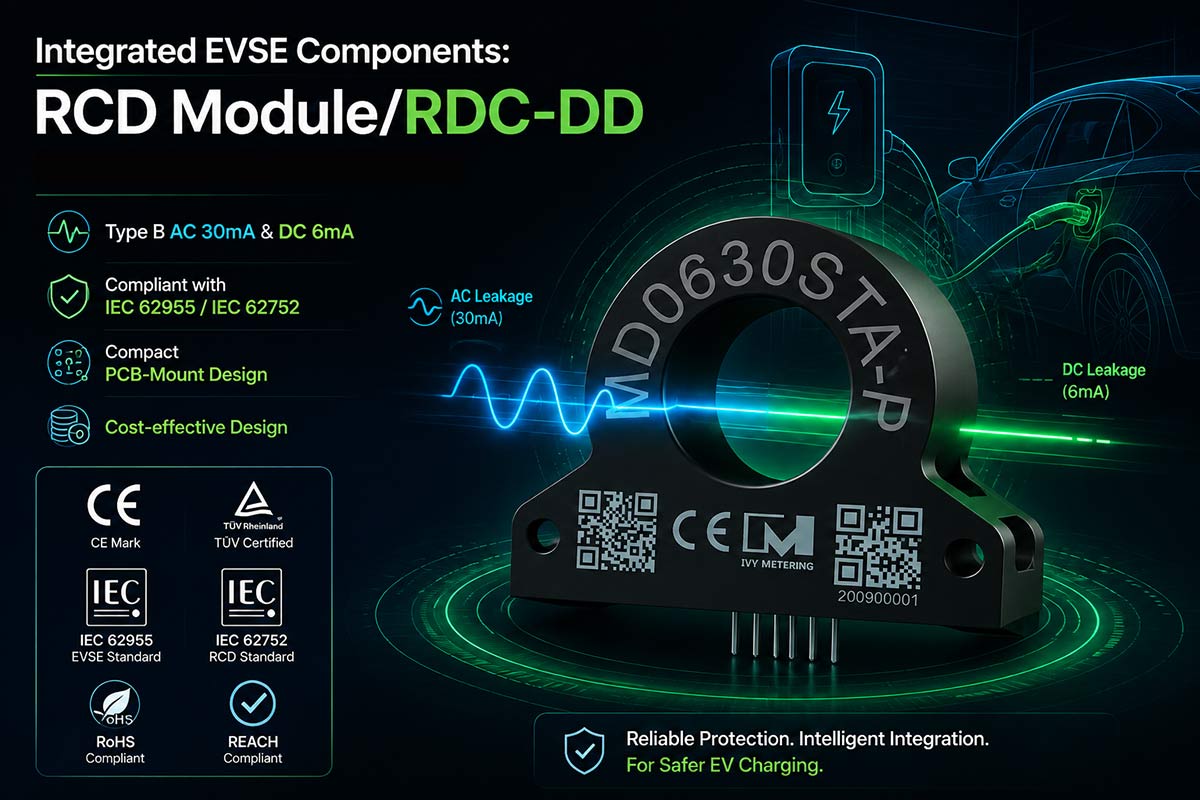
2. RDC-DD (Residual Direct Current Detecting Device)
The RDC-DD is a "specialized detection device" developed in recent years specifically for EV charging stations.
Capabilities: It acts as a "specialist." Its specific function is to detect smooth DC leakage currents of 6mA. Once the DC leakage exceeds 6mA, it sends a signal, prompting other components within the charging station (such as relays or contactors) to cut off the power supply.
Structural Characteristics: It typically does not include a physical tripping switch; instead, it functions purely as a leakage current sensor module.
Standards: IEC 62955.
II. Solution Showdown: Which Integration Approach Wins for EVSE?
For EVSE OEMs, integrating leakage protection into increasingly compact charging stations requires striking a perfect balance between regulatory compliance, physical size, heat generation, and cost.
Round 1: Safety Compliance and System Architecture
Traditional RCD: Cramming a full Type B RCD into a charging station covers all leakage risks. However, standard Type B RCDs are designed for power distribution cabinets; forcing them into a charging station significantly complicates the internal structure.
RDC-DD: European charging standards permit a highly flexible combined architecture: a low-cost Type A RCD installed at the grid connection (handling AC leakage protection) paired with an RDC-DD integrated inside the charging station (specifically detecting 6mA DC leakage). When the RDC-DD detects a 6mA DC anomaly, it rapidly disconnects the internal relay, preventing the upstream Type A RCD from becoming "blinded" (saturated). This combination fully complies with IEC 62955 and IEC 61851-1 standards and is the standard approach adopted by leading charging station manufacturers in Europe and the US.
Conclusion: The RDC-DD combined architecture aligns better with the trend toward flexible EVSE design.
Round 2: Space Footprint and Thermal Management
Traditional RCD Module: These are bulky, typically occupying four DIN-rail module spaces. Furthermore, because they integrate mechanical trip mechanisms and current-carrying components, they generate significant heat when conducting high currents (e.g., 32A) over extended periods—a thermal management disaster for sealed charging station enclosures (such as IP65-rated wall-mounted units).
RDC-DD Sensor: As an integrated component, it can be designed as a tiny PCBA pin-mount module or a compact through-hole sensor. It does not carry the main circuit's load current (eliminating the need for heat dissipation) and simply performs "silent monitoring," allowing it to be soldered directly onto the charging station's main control board.
Conclusion: The RDC-DD offers a vastly superior solution regarding size and thermal management.
Round 3: BOM Cost and Integration Complexity
Traditional RCD Modules: Industrial-grade Type B RCDs are extremely expensive (often exceeding $100); equipping every AC charging pile with one would render the unit's total BOM cost uncompetitive in the market.
RDC-DD Sensors: These cost only a fraction of a Type B RCD. By leveraging the charging pile's existing main control MCU and cut-off relay, the overall system cost is significantly reduced. Furthermore, high-quality RDC-DDs output digital signals (such as UART or PWM) that the MCU can use directly, substantially lowering the barrier to hardware development.
Conclusion: The RDC-DD is the only path to achieving an optimal cost-performance ratio.
III. Your Preferred Integration Solution: [IVY Metering] RDC-DD Residual Current Sensor
To address the integration challenges faced by EV charging manufacturers targeting overseas markets, we have launched the [MD0630T01A/MD0630STA-P] RDC-DD sensor module—specifically customized for EVSE applications.
Designed for PCB Integration: Features an ultra-compact pin-mount or through-hole design, saving every millimeter of valuable circuit board space.
Facilitates CE/IEC 62955 Certification: Built-in advanced filtering algorithms effectively eliminate parasitic capacitance interference in harsh environments, putting an end to customer complaints regarding "false tripping."
Streamlined Development: Directly outputs high/low logic levels or PWM/UART digital signals; includes comprehensive peripheral reference circuits and test reports to help you launch your new products in the European market ahead of the competition.
Ready to upgrade your charging station's safety architecture?
Don't let complex residual current protection selection slow down your R&D. Contact us today to get the detailed datasheet!