

Comparison of Split Core WiFi Power Sensor and Lorawan Energy Meter
Split-core WiFi power sensors and LoRaWAN energy meters are both key devices in Internet of Things (IoT) power monitoring solutions. The former uses a current transformer (CT) clipped onto the power line and uploads data via WiFi, focusing on localized, rapid deployment. The LoRaWAN energy meter, on the other hand, connects directly to the circuit, providing more accurate electrical parameters (voltage, current, power, etc.) and achieving long-distance, low-power data transmission via LoRaWAN, suitable for large-scale, granular management.
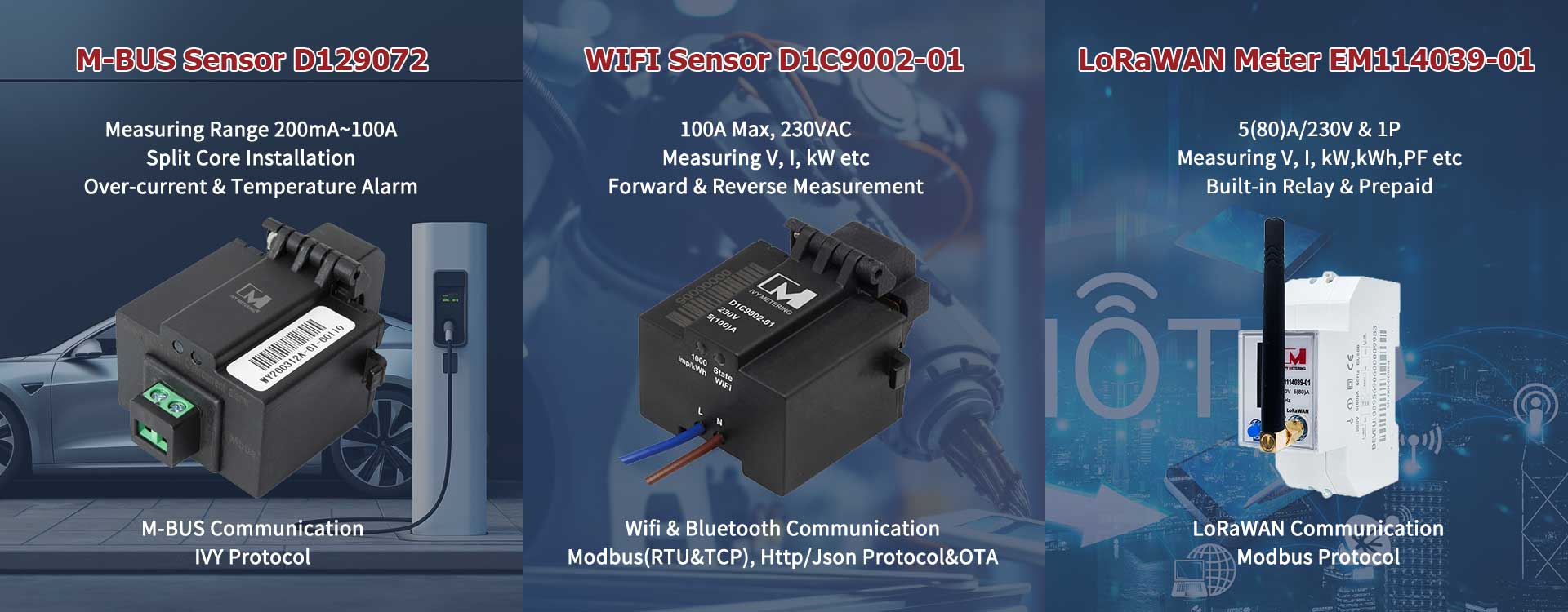
Split-core WiFi Power Sensor:
Working Principle: The core component is the CT (current transformer), which senses current without requiring the power line to be cut, making installation convenient.
Connectivity: Data is sent to the cloud or a local server via a Wi-Fi network.
Advantages: Easy to install, relatively low cost, suitable for home and small commercial environments, monitoring the energy consumption of specific devices or lines.
Disadvantages: Wi-Fi network coverage and stability are limitations; data transmission rate and power consumption are higher than LoRaWAN.
LoRaWAN Energy Meter
Working Principle: A smart energy meter that directly measures electrical energy (energy consumption, voltage, current, power, power factor, etc.).
Connectivity: Employs LoRaWAN communication technology for long-distance, low-power, and highly reliable data transmission.
Advantages: Comprehensive measurement parameters, high accuracy, long data transmission distance, suitable for large-scale deployment, remote centralized meter reading, smart cities, and industrial energy management.
Disadvantages: Relatively high deployment cost, requiring a LoRaWAN gateway and network server.
Comparison of Selection and Application
Scenario: For quick, small-scale monitoring of power consumption in a specific outlet or device, use a switchable WiFi sensor; for precise, long-distance management of power across an entire building or industrial park, choose a LoRaWAN energy meter.
Functions: WiFi sensors focus on simple power/energy monitoring; LoRaWAN meters provide comprehensive power parameters and more precise metering.
Network: WiFi relies on an existing WiFi network; LoRaWAN requires the deployment of a LoRaWAN network (gateway).
In general, the two are complementary. The appropriate solution should be selected according to specific needs, or they can be used together in large-scale projects to achieve efficient power data management.