
How DC Leakage Current Detection Works in EV Charger?
With the widespread adoption of electric vehicle supply equipment (EVSE), charging safety has become a primary focus of the industry. In the internal design of EV charging stations (such as AC wallboxes or IC-CPD cables), a key technical specification frequently discussed by engineers is 6mA smooth DC leakage protection.
So, why is DC leakage detection necessary for EV charging? How exactly is this detection performed within such a compact sensor? This article explains the technical principles behind DC leakage detection in EV chargers.
1. Why is DC leakage detection essential?
Electric vehicle (EV) batteries operate on high-voltage direct current (DC), whereas the power grid supplies alternating current (AC). During charging, the on-board charger (OBC) converts AC into DC. If the vehicle's insulation is compromised, high-voltage DC could leak through the charging cable into the household or building's AC grid.
High risk of going undetected: Smooth DC leakage currents are small (in the milliampere range) but persistent; the magnetic cores in traditional Residual Current Devices (RCDs) saturate at levels above 6mA, causing the protection mechanism to fail.
Significant hazards: The risk of electric shock from DC is comparable to that of AC, yet it is harder to break free from; it can easily lead to fires or equipment damage.
To prevent such incidents, the International Electrotechnical Commission (IEC) mandates that EV charging stations must be capable of detecting and interrupting 6mA DC leakage.
2. Core Technology for DC Leakage Detection: The Fluxgate Principle
Traditional AC leakage detection is straightforward: it employs a Zero-Sequence Current Transformer (ZCT). Based on the law of electromagnetic induction (Faraday's Law), the alternating magnetic field generated by Alternating Current induces a voltage in the secondary coil. However, smooth Direct Current does not generate an alternating magnetic field; consequently, traditional transformers remain "blind" to it. To detect minute DC leakage currents as low as 6mA, the leakage monitoring units (RCMU/Type B sensors) in modern EV chargers utilize highly sensitive Fluxgate technology. The process involves three steps:
Step 1: Active Excitation
The sensor contains a dedicated "excitation coil." An internal microprocessor feeds a high-frequency square-wave oscillating current into this coil, forcing the toroidal magnetic core to switch repeatedly between positive and negative saturation.
Step 2: Breaking the Balance (Asymmetry)
When the charging cables (Line L and Neutral N) pass through the magnetic core, the system operates normally if the vector sum of the currents in L and N is zero; in this state, the core's oscillation waveform remains symmetrical.
If DC leakage occurs, the weak DC-current generates a constant, directional magnetic field. This constant field superimposes onto the otherwise symmetrical alternating magnetic field, causing the magnetic core to reach saturation "early" in one specific direction.
Step 3: Precise Detection and Alarm Triggering
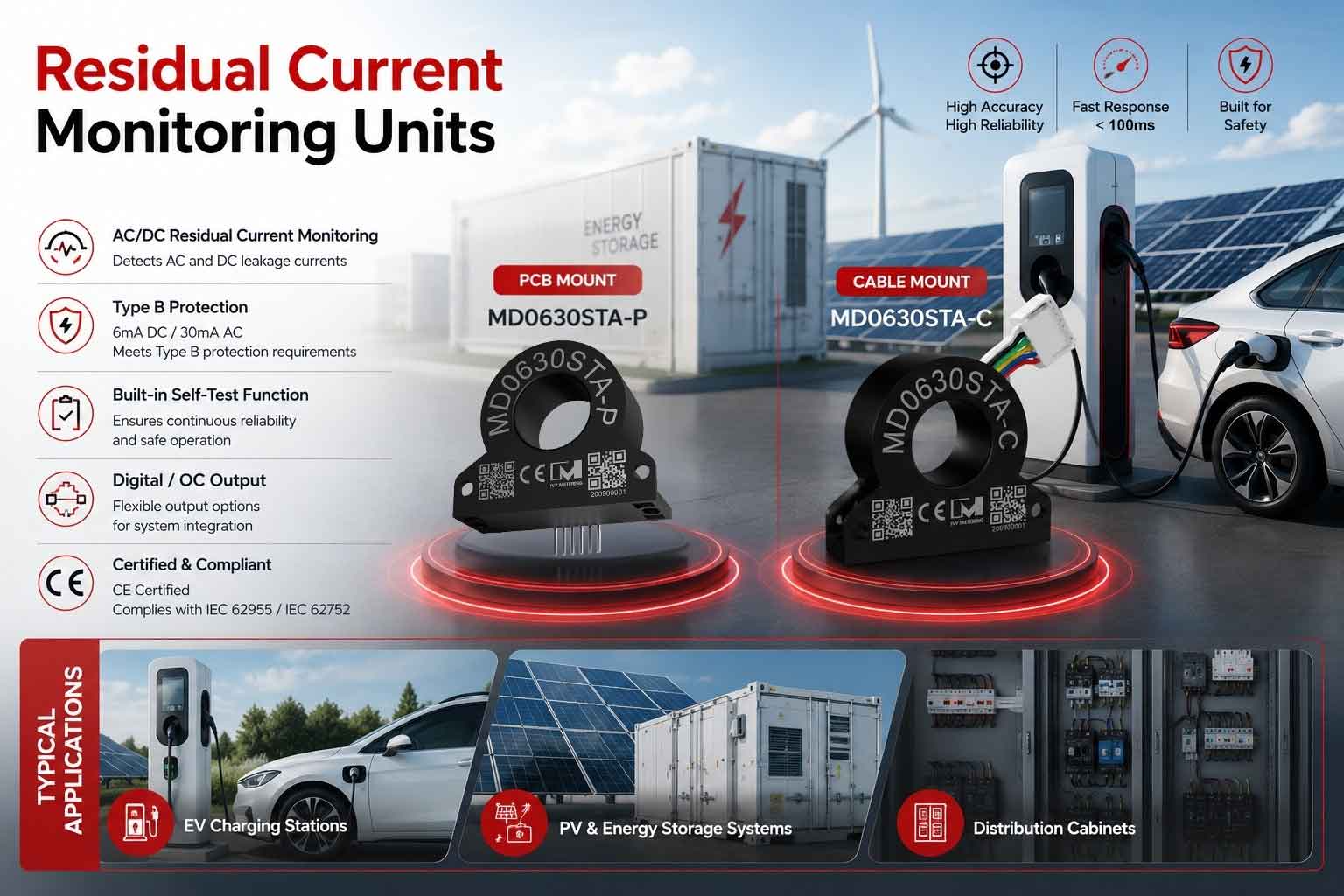
Once the waveform becomes asymmetrical, the sensor's high-precision detection circuitry (signal conditioning chip) captures the distortion. Complex algorithms convert this distortion into a specific current value. If the calculated DC leakage exceeds 6mA (or AC leakage exceeds 30mA), the sensor immediately outputs a digital signal (such as pulling a pin to a low voltage level). This notifies the charging station's mainboard to instantly disconnect the relay and halt the charging process.
3. Compliant EV Charger Design: IEC 62955 and Type B Standards
According to IEC 62955 (for Mode 3 charging stations) and IEC 62752 (for Mode 2 portable charging cables IC-CPD), charging equipment must be capable of detecting 30mA AC and 6mA DC leakage currents. There are currently two mainstream design approaches:
Option A: External installation of a Type B residual current circuit breaker. This approach is bulky and expensive; it often requires users to modify their distribution boxes during installation, resulting in a poor user experience.
Option B: Built-in RCMU (Residual Current Monitoring Unit). This is the preferred choice for leading global EV charger manufacturers. It involves soldering a highly integrated Type B leakage sensor (Integrated RCD) directly onto the charger's PCBA, working in conjunction with an onboard relay to cut off power. This not only significantly reduces the charger's physical size but also drastically lowers the overall BOM (Bill of Materials) cost.
4. Conclusion: Ensuring Ultimate Safety for Next-Generation EV Chargers
DC leakage detection may seem like a minor technical detail, but it is directly linked to the safety of EV users and the stability of the power grid. Mastering core fluxgate leakage detection technology is key to creating high-quality, compliant EV charging equipment.
Are you looking for a reliable leakage protection solution for your next EV charger project? At IVY Metering, we offer high-precision Type B RCD sensors designed specifically for EV charging. Our modules utilize advanced fluxgate technology to accurately detect 30mA AC / 6mA DC leakage. They feature a compact design and support both digital and switching outputs, fully enabling your products to meet rigorous IEC certification standards.