
Pulse vs Motor-Driven Relays: Which is Better for Smart Meters?
As global power grids evolve toward Advanced Metering Infrastructure (AMI), smart meters are transforming from passive data loggers into active load management terminals. The core component enabling this critical "connect/disconnect" function is the latching relay.
For years, meter designers have faced a pivotal choice: stick with traditional pulse-driven latching relays or upgrade to the new generation of motor-driven latching relays? In this article, we'll break down the mechanics, vulnerabilities, and performance differences between the two, and explain why leading utility companies are aggressively shifting toward motor-driven solutions.
1. Traditional Choice: Pulse-Driven Latching Relay
Operating Principle: Pulse-driven relays (also known as magnetic latching relays) operate using an electromagnetic coil and a permanent magnet. A brief electrical pulse energizes the coil to actuate the armature and switch the contact position; a permanent magnet then holds the contacts in that position without requiring further power consumption.
Advantages:
Cost-effectiveness: Mature technology with relatively low manufacturing costs.
Energy efficiency: Like other latching relays, no power is consumed to maintain the state.
Critical Flaws in Modern Grid Applications:
Vulnerability to tampering (electricity theft): Because pulse relays rely on internal magnets to maintain contact status, they are highly susceptible to external magnetic field interference. In many regions, users employ powerful neodymium magnets to force the relay contacts closed, thereby bypassing the metering system.
Risk of contact welding: The magnetic pulling force is limited. In the event of a severe short-circuit, the contacts can melt and weld together, rendering the relay unable to disconnect the load.
2. Next-Generation Solution: Motor-Driven Latching Relay
Operating Principle: Unlike relays that rely solely on magnetic coils, motor-driven relays utilize a miniature DC motor combined with a precision gear train to physically actuate the contacts and lock them into position.
Revolutionary Advantages:
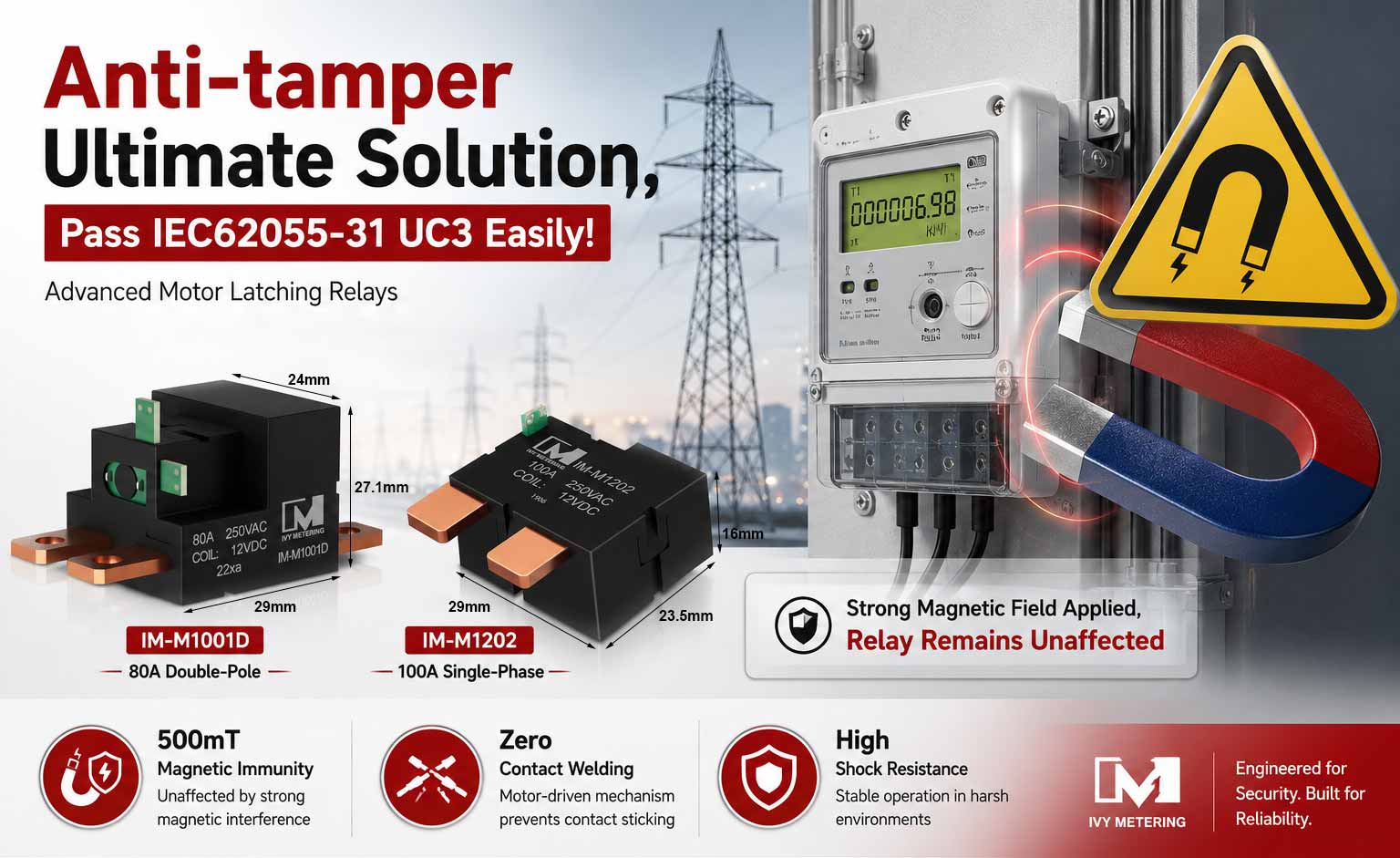
Superior Tamper Resistance (500mT Magnetic Immunity): Because the locking mechanism is entirely mechanical (gear-based), it is unaffected by external magnetic fields. These relays easily withstand magnetic interference of up to 500mT, effectively eliminating electricity theft attempts involving magnetic fields.
High Switching Force and Zero Welding: The driving torque generated by the miniature motor far exceeds that of magnetic coils. Even under extreme short-circuit currents, the motor provides sufficient physical force to forcibly separate welded contacts, easily meeting the rigorous IEC62055-31 UC2 and UC3 standards.
Excellent Shock and Impact Resistance: The mechanical self-locking structure ensures that the relay does not malfunction or change state due to physical impact, transport vibrations, or harsh industrial environments.
3. The Verdict: Which relay is Better?
While pulse-driven relays are still suitable for basic, low-risk environments, they are rapidly becoming obsolete in high-security, revenue-critical grid networks.
If your smart meter design needs to meet anti-tampering requirements, survive harsh grid fluctuations, and comply with strict IEC UC3 standards, the Motor-Driven Relay is unequivocally the better, future-proof choice.
Empower Your Smart Meters with IVY Metering
At IVY Metering, we understand the immense pressure engineers face to design fail-proof smart meters. That is why we engineered the IM-M1005 and IM-M1202 Motor-Driven Latching Relays.
Specifically designed for top-tier smart grid applications, the IM-M1005 & IM-M1202 offer:
80A / 100A robust load switching.
500mT Magnetic Immunity, stopping electricity theft at the source.
Full compliance with IEC62055-31 UC2/UC3 standards.
Ultra-compact design to save critical PCB space.
Stop compromising on the heart of your smart meter. Upgrade to mechanical reliability and secure your utility revenue today.