
Residual Current Monitoring Relay vs Residual Current Sensor: What's the Difference?
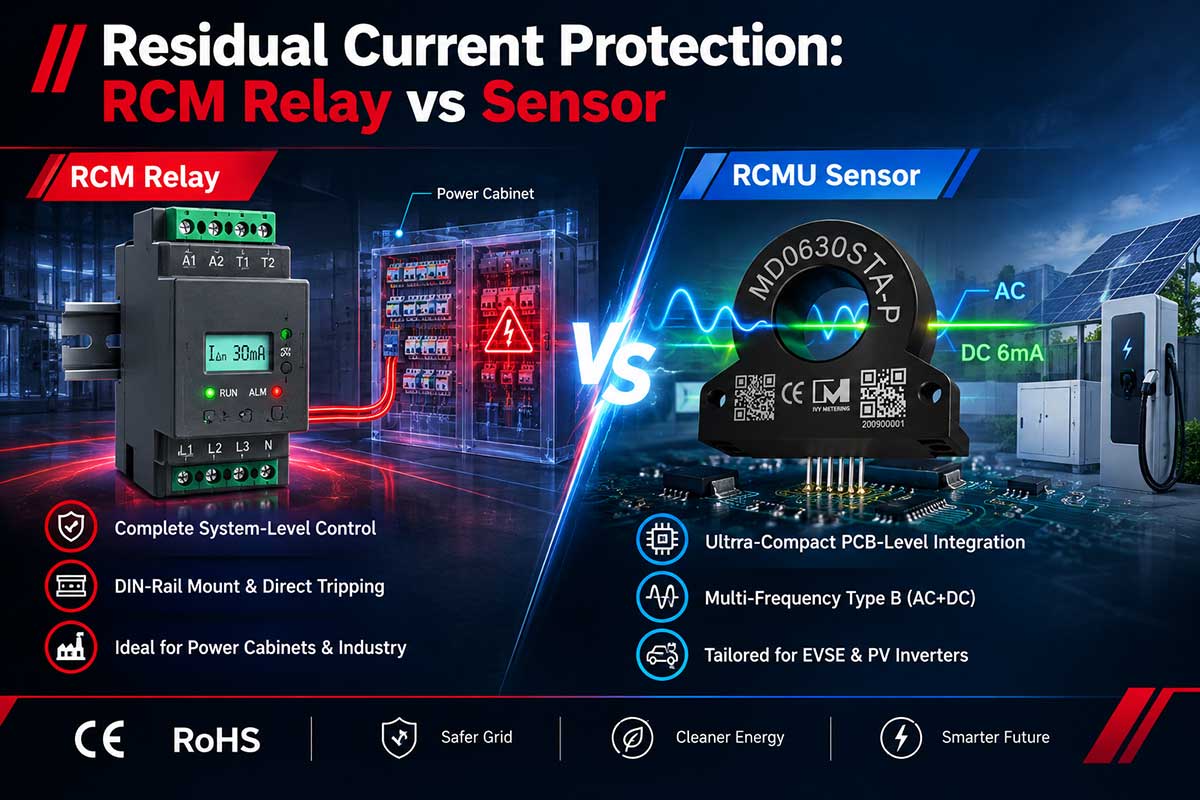
In the context of electrical safety and residual current protection design, a Residual Current Monitoring Relay (RCMR) is a standalone protection device featuring mechanical contact outputs, typically used for independent alarming or tripping in industrial power distribution cabinets. In contrast, a Residual Current Sensor (RCS/RCMU) is a highly integrated, intelligent measurement module at the PCBA level that outputs digital signals (such as UART or PWM) directly to the system MCU. For modern equipment requiring compact dimensions and highly intelligent control—such as EV charging stations and PV inverters—an integrated residual current sensor (RCMU) represents the optimal architectural choice.
With the rapid growth of new energy sectors (such as EV charging and PV energy storage) and the Industrial Internet of Things (IoT), requirements for monitoring "leakage current" (residual current) have evolved beyond traditional "pure AC" detection to encompass complex high-frequency and DC components (Type B).
When designing residual current protection architectures, electrical engineers often confuse two core components: the Residual Current Monitoring Relay (RCMR) and the Residual Current Sensor (RCS, also commonly referred to as RCMU). Although both detect leakage current, they play distinctly different roles at the system level.
1. What is a Residual Current Monitoring Relay (RCMR)?
An RCMR is a "self-contained, all-in-one" device.
Product Form: It is typically a complete, enclosed unit (usually DIN-rail mounted) that integrates a current transformer (or supports an external one), signal processing circuitry, and a mechanical relay (dry contact).
Operational Logic: It operates based on pure hardware logic. When it detects leakage current exceeding a preset threshold (e.g., 30mA), the internal relay triggers immediately (closing a normally open contact or opening a normally closed contact).
Application Scenarios: It is primarily used in traditional industrial control cabinets and data center power distribution boxes. It functions by connecting its relay contacts in series with an external circuit breaker's trip coil or by directly activating an alarm light. It can independently perform the "detect and act" sequence without relying on an external microcontroller (MCU).
II. What is a Residual Current Sensor (RCD/ RCMU)?
An RCS (Residual Current Sensor) or RCMU (Residual Current Monitoring Unit) acts as a "highly intelligent monitor."
Product Form: It is typically an ultra-compact PCBA module (featuring a pass-through aperture) that is either soldered directly onto the customer's mainboard via pins or connected via a ribbon cable.
Operational Logic: It relies on hardware-software synergy. Its sole function is to perform highly precise measurements and transmit real-time leakage current waveforms, numerical values, or alarm statuses to the device's main control chip (MCU) via digital signals (UART, PWM, or high/low logic levels). The MCU ultimately decides whether to cut off the main circuit.
Application Scenarios: Designed specifically for highly integrated, intelligent modern electronic devices, such as EV AC charging stations (Wallboxes), micro-inverters for PV systems, and smart gateways.
III. Comparison of Core Architectures: RCMR vs. RCS (RCMU)
| Evaluation dimensions | Residual current monitoring relay | Residual current monitoring sensor |
| System Roles | Independent actuator (measurement + contact action) | Intelligent sensing node (precision measurement + data transmission) |
| Signal output method | Physical dry contact (Relay NO/NC) | Digital signals (UART, digital levels)/Open collector output |
| Dimensions and Installation | Large in size, DIN-rail mounted, and occupies significant space. | Space-saving; PCBA pin soldering or ribbon cable connection. |
| Self-test function | The mechanical "Test" button on the surface of the device must be pressed manually. | Automatic triggering. The MCU completes the safety self-test within milliseconds by driving the pin level high or low. |
| Target application scenarios | Retrofitting of power distribution systems and leakage protection upgrades for older factory facilities. | EV charging stations (IEC 62955), PV inverters, smart hardware. |
IV. Embracing Intelligence: IVY Metering's Flagship RCM (Residual Current Monitoring) Series
As EV charging stations and PV systems expand into European markets, traditional RCMRs can no longer meet the demands for device miniaturization or the rigorous digital communication and self-test requirements of IEC 62955 and IEC 62109 standards.
As a global leader in electrical measurement components, IVY Metering has developed the MD Series Type B RCD specifically for board-level integration into modern smart hardware. It has become the go-to solution for top-tier charging station manufacturers to ensure standards compliance:
Top Recommendation: MD0630T01A (Through-hole Pin Version)
Global Standard-Ready: Specifically designed to meet the IEC 62955 standard for EV charging stations; accurately detects 6mA smooth DC and 30mA AC leakage currents, effectively eliminating the blind spots associated with Type A residual current devices.
Direct Digital Connectivity: Features a standard UART interface for direct communication with your host MCU, enabling seamless real-time leakage data acquisition and supporting simple pin-level self-testing.
Flexible Installation: Comes with a dedicated wiring harness, allowing for flexible sensor placement within compact enclosures—keeping it away from heat sources.
Space-Optimized Design: Utilizes a vertical pin-to-board soldering design for direct integration onto your main PCB, minimizing the footprint to the absolute limit—ideal for portable charging boxes (IC-CPD) and micro-inverters.
Choose IVY Metering residual current sensors to enable your equipment to easily meet international safety standards with a more compact footprint and a smarter architecture. [Contact us today to get the datasheet and samples for the MD series sensors!]