
EVSE Architectural Dilemma: RCMU vs Type B RCCB (IEC 62955 Compliance Guide)
During AC charging of electric vehicles, if an insulation fault occurs in the on-board charger (OBC), smooth DC leakage current can easily be injected back into the AC grid. This not only poses a risk of electric shock but also causes conventional Type A residual current devices (RCDs) at the grid interface to fail due to "magnetization-induced blinding."
To address this critical issue, the latest European regulations mandate that charging stations possess leakage protection capabilities of 30mA AC + 6mA DC. EVSE electrical architects face two options: a Type B RCCB or an RCMU. Which one should be chosen?
1. Definitions: What are they? "Residual Current Protection Devices"
1. Type B RCCB (Residual Current Circuit Breaker)
This is a traditional, bulky, mechanical residual current circuit breaker. It is a complete physical unit containing a zero-sequence current transformer, a fluxgate sensor, a trip coil, and mechanical arc-extinguishing contacts.
Standards: IEC 62423 / EN 50539
Operating Logic: Purely hardware-based. Upon detecting AC or DC leakage exceeding the threshold, the internal mechanical trip mechanism physically disconnects the circuit (with an audible "snap").
2. RCMU (Residual Current Monitoring Unit)
This is a high-tech, intelligent residual current sensor module, typically a small PCBA with a central aperture (through-hole). It "monitors only; it does not actuate."
Standard: IEC 62955
Operating Logic: A combination of hardware and software. It precisely measures residual current (covering AC and 6mA DC); upon detecting a hazard, it outputs a digital signal (e.g., high/low level) to the charging station's
main control MCU. Upon receiving the signal, the MCU commands the relay or contactor in the main power circuit to disconnect the power.
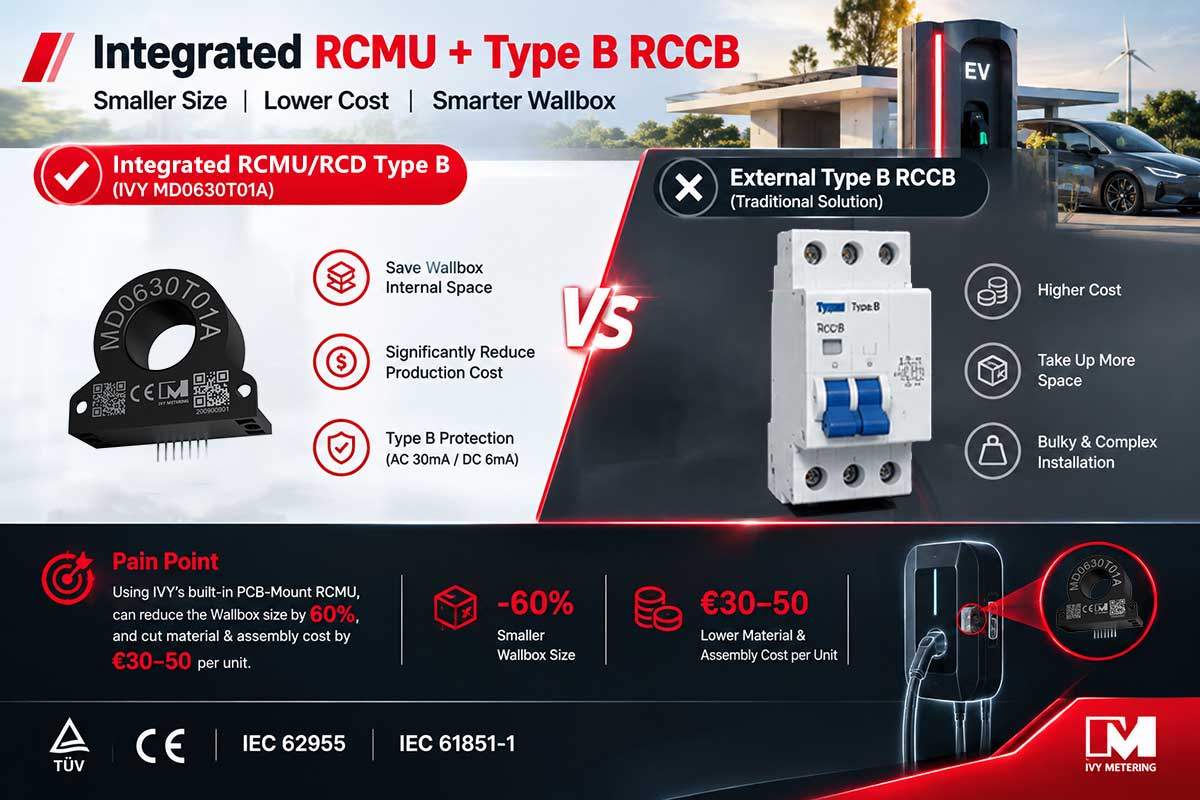
II. Comparison: RCMU vs. Type B RCCB
| Evaluation dimensions | Type B RCCB | Integrated RCMU + Relay |
| Physical volume | Large size (occupies 4 DIN rail modules in the distribution box). Surface-mounted. | Ultra-compact. Features a compact PCBA pin-to-board design (with through-hole options available) |
| BOM Cost | Very high (Type B RCCBs from top-tier brands typically cost over €50–€100). | Low cost. Compared to Type B RCCBs, the cost is reduced by at least 40%. |
| Self-test function | Performing mechanical tests requires manually pressing the "Test" button on the device at regular intervals, which is extremely inconvenient. | The main control chip triggers the process automatically. The RCMU is equipped with a dedicated test pin, allowing the MCU to send a signal command to perform a safety self-test prior to each charging session. |
| Short circuit breaking capacity | It features built-in miniature circuit breaker functionality, capable of interrupting short-circuit currents of several thousand amperes. | The RCMU is responsible only for earth leakage protection; short-circuit protection relies on an MCB or relay in the main circuit (which must comply with the UC3 standard). |
III. Case Study: (Unveiling RCMU Pain Points)
Let's look at the numbers: "In Europe, the cost of manually wiring a single connection is at least 50 euros. A traditional Type B RCCB occupies 4U of DIN-rail space, forcing the charging station unit to be bulky and unsightly. In contrast, using IVY’s RCMU with direct PCB mounting cuts assembly time by a full 60%..."
[A Critical Pain Point in a Real-World Scenario]
A Chinese EV charging station manufacturer designed a high-end 22kW AC charger for export to Europe. To save time and effort, the R&D team simply installed an expensive, conventional Type B RCCB inside the unit.
Late one stormy night, a car owner plugged in the charging cable to start a session. Because the combination of rainwater and the long charging cable naturally created significant "high-frequency parasitic capacitance," a harmless high-frequency capacitive leakage current of approximately 20mA was generated the moment charging began.
Adopting an RCMU + relay architecture completely changes the scenario:
1. Intelligent filtering to prevent false alarms: High-end RCMUs feature powerful built-in digital filtering algorithms that accurately filter out parasitic capacitance interference caused by thunderstorms; they detect only genuine, hazardous leakage currents, thereby eliminating "phantom trips."
2. Automatic reclosing (Auto-Recovery): Even if an occasional leakage event triggers the RCMU to cut off the relay, the MCU can use software commands to automatically re-engage the relay (reclosing) and resume charging once the leakage condition clears—all without the vehicle owner needing to go downstairs and intervene manually.
IV. Your Ultimate Compliance Solution: IVY Metering MD0630 Series RCMU(Integrated RCD)
Recognizing the rigorous IEC 62955 standards and the pain point of nuisance tripping facing EVSEs entering the global market, IVY Metering has developed a flagship residual current monitoring solution—the MD0630 series RCMU—specifically for global charging station R&D teams.
It is more than just a sensor; it is your "golden ticket" to European market entry.
Key Technical Strengths of the MD0630 Series:
Full IEC 62955 Compliance: Precisely detects 6mA smooth DC and 30mA AC leakage currents, eliminating the blind spots associated with Type A RCDs and ensuring you pass rigorous TÜV/CE testing on the first attempt.
Designed for Compact Spaces: Features a compact PCBA pin-to-board design (with through-hole options available) that integrates seamlessly into your PCB layout, eliminating concerns regarding heat dissipation and space constraints.
Simplified Digital Integration: Equipped with an integrated UART digital interface that feeds clean leakage current data directly to the MCU. Includes a dedicated self-test trigger pin, enabling automatic power-on self-tests within milliseconds.
Robust Immunity to High-Frequency Interference: Built with industrial-grade anti-interference algorithms and high-permeability magnetic cores, it maintains rock-solid stability—even in harsh environments involving variable frequency drives (VFDs), PV harmonics, or capacitive interference from thunderstorms—minimizing nuisance tripping to the absolute limit.
Adopt the IVY Metering RCMU solution today to build next-generation EVSE that is smaller, smarter, and fully compliant with upcoming European 2026 standards.
[Contact Us now to obtain MD0630 series specifications and IEC 62955 certification reference data.]