

DC Meters with Ethernet: The Top Choice for DC Metering System
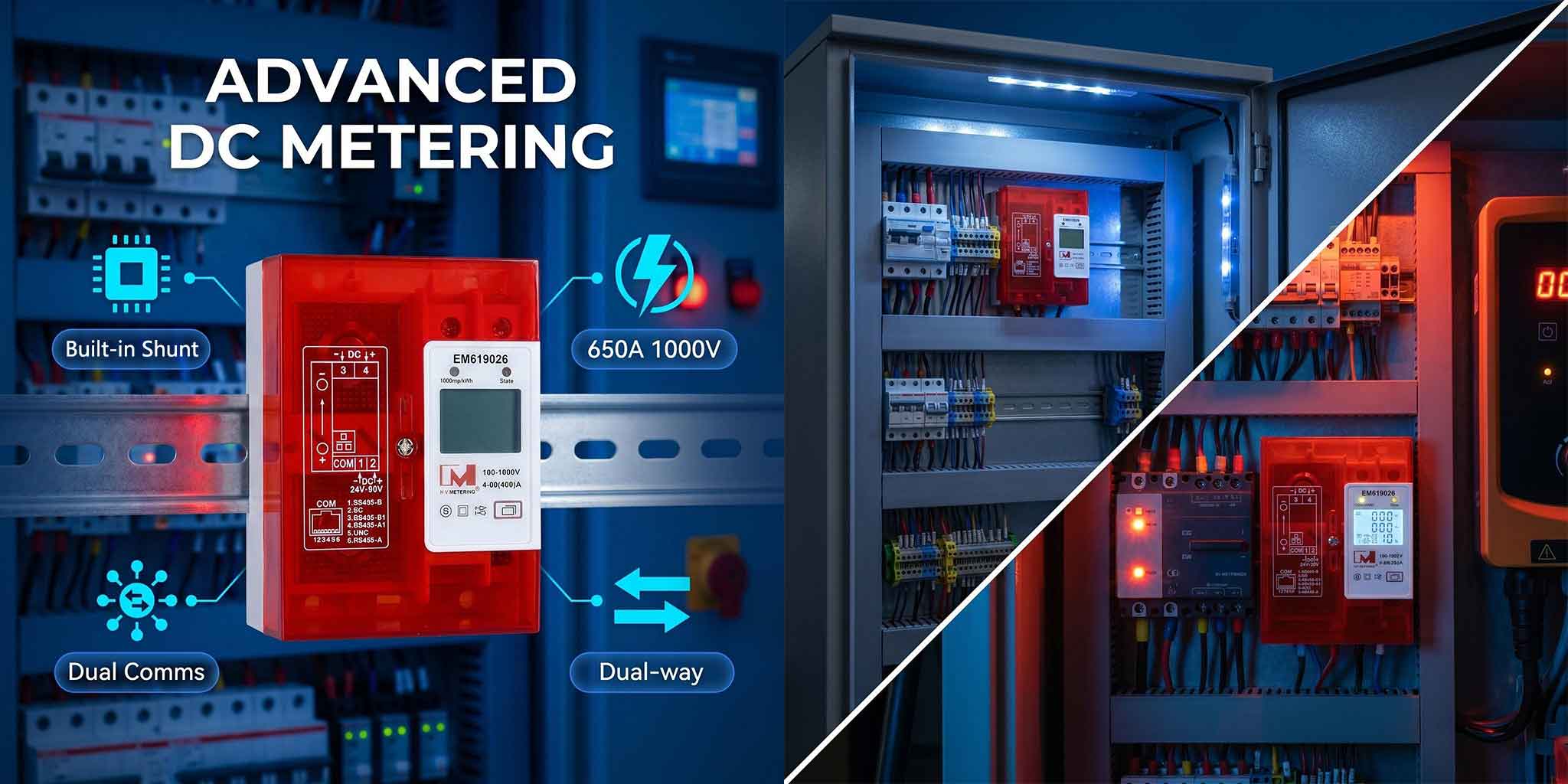
DC meters are typically used to measure voltage, current, power, and energy in DC systems. When a DC meter is equipped with an Ethernet communication interface (such as RJ45), it becomes a smart gateway device, capable of high-speed, long-distance data transmission and direct network connectivity.
Features:
High transmission rate and low latency: Compared to traditional RS485 serial communication, Ethernet offers bandwidths of hundreds of megabits or even gigabits, enabling real-time acquisition of transient DC voltage and current data, suitable for high-frequency data updates.
Rich network protocols: Supports standard TCP/IP protocols and easily supports Modbus-TCP, MQTT, HTTP/HTTPS, SNMP, and other protocols, facilitating access to enterprise intranets, cloud platforms, or the Industrial Internet.
PoE (Power over Ethernet) support: Some high-end meters support PoE technology, allowing power to be transmitted simultaneously over the data transmission line, reducing power cabling per meter.
Remote operation and maintenance/diagnosis: Supports remote parameter configuration, system updates, and time synchronization, making network fault diagnosis more convenient.
High Security and Isolation: IP-based industrial Ethernet offers superior signal isolation and data encryption in high-voltage environments.
Advantages:
Low Integration Costs and Convenient Networking: Eliminates the need for complex serial bus networking and protocol converters (gateways), leveraging existing LAN infrastructure.
High Reliability and High Capacity: Ethernet switch topologies (star or ring) allow thousands of nodes to operate stably simultaneously, unaffected by single-point failures.
Connectivity to Cloud Services and Digital Operations: Easily enables direct communication with cloud platforms and big data centers, facilitating energy management, data analysis, and predictive maintenance.
Strong Interoperability: Utilizes internationally recognized protocols, ensuring compatibility between devices from different manufacturers within the same network and meeting the integration requirements of complex smart energy systems.
Strong Anti-Interference Capabilities: Ethernet shielded twisted-pair cables offer stronger resistance to DC electromagnetic interference than RS485 cables, ensuring accurate data acquisition.
Based on customer needs and continuous innovation, IVY Metering is about to launch three new MID-certified DC meters, with the following key features:
● Comprehensive metering functions: Forward and reverse energy measurement
● Accuracy class 1
● Multiple rates and time periods: The product defaults to 4 rates and 8 time periods.
● Flexible communication methods: Supports RS485 and Ethernet communication.
● Backlit LCD-display: Displays voltage, current, power consumption, power, etc.; features automatic rotation display with a default interval of 5 seconds.
● Self-diagnostic, alarm, and safety functions
● Line loss and energy consumption compensation
● OCMF readings compliant with S.A.F.E. standards
Typical Application Scenarios:
New Energy EV Charging Stations: Especially DC fast charging piles, requiring real-time metering and billing, high-frequency recording of charging data, and uploading to the operation platform.
Data Centers and Computer Rooms (DC-powered): Accurately monitoring power utilization efficiency (PUE) in high-voltage direct current (HVDC) power distribution systems and PDUs in server racks.
Solar Photovoltaic and Energy Storage Systems: Used for monitoring the operating parameters of photovoltaic combiner boxes and DC energy storage battery packs, directly transmitting data to the SCADA system.
Rail Transit and DC Traction Systems: Power supply systems perform high-precision real-time billing and safety monitoring of DC power consumption.
Smart Microgrids: Used as data acquisition nodes in the power distribution and energy management system (EMS) of DC microgrids.
DC energy meters with Ethernet interfaces are primarily used in electric vehicle (EV) charging stations, photovoltaic energy storage systems, data centers, and industrial battery monitoring. These devices support Modbus TCP or BACnet/IP protocols via RJ45 ports, enabling remote real-time monitoring and analysis of data.