
Revealing the Role of Latching Relays in Smart Energy Meter
In today's global energy transition towards digitalization and intelligence, smart meters are no longer just wall-mounted measuring tools that "record how much electricity is used." They are the nerve endings of Advanced Metering Architectures (AMIs), and the core terminals for power companies to achieve remote cost control, tiered pricing, load management, and even anti-theft measures.
However, the reason smart energy meters can evolve from "data-reading" observers to "power cut-off/restoration" executors relies entirely on a seemingly insignificant yet crucial component hidden on their PCBA motherboard—the latching relay (also commonly known as a magnetic latching relay/bistable relay). Today, we'll delve into why this tiny component is called the "core component" of a smart energy meters.
Key Functions of Latching Relays in Smart Meters
Function 1: The "Executor" of Remote Bill Control and Load Management
A major challenge for modern utility companies is electricity bill collection. Smart meters utilize built-in high-current latch relays (typically 60A to 120A) to enable prepaid systems. When a user's balance is depleted, the meter's main control chip sends a pulse signal to the relay, causing it to instantly disconnect, cutting off power to residential or commercial loads. When the user tops up, another pulse restores power instantly.
Simultaneously, during extreme peak periods of grid overload, power companies can even remotely issue commands via the network to cut off power to non-critical nodes through the relay, protecting the main power grid.
Function 2: Low Power Consumption and Extended Meter Lifespan
As mentioned earlier, the "zero-power sustaining" characteristic of holding relays directly eliminates the heat generated by the relay coil's continuous energization. Within the sealed meter casing, temperature rise is the leading cause of aging electronic components and decreased metering accuracy. The application of holding relays not only reduces the power consumption of the meter itself but also significantly improves the operational stability of the entire meter over its 15-year lifespan.
Function Three: Resisting Short-Circuit Impacts, Building a Firewall for Power Grid Safety
In real-world power grid environments, lightning strikes or terminal equipment failures can easily cause massive instantaneous short-circuit currents. If the relay contacts fuse (stick together) at this time, power will not be cut off, posing a serious fire hazard.
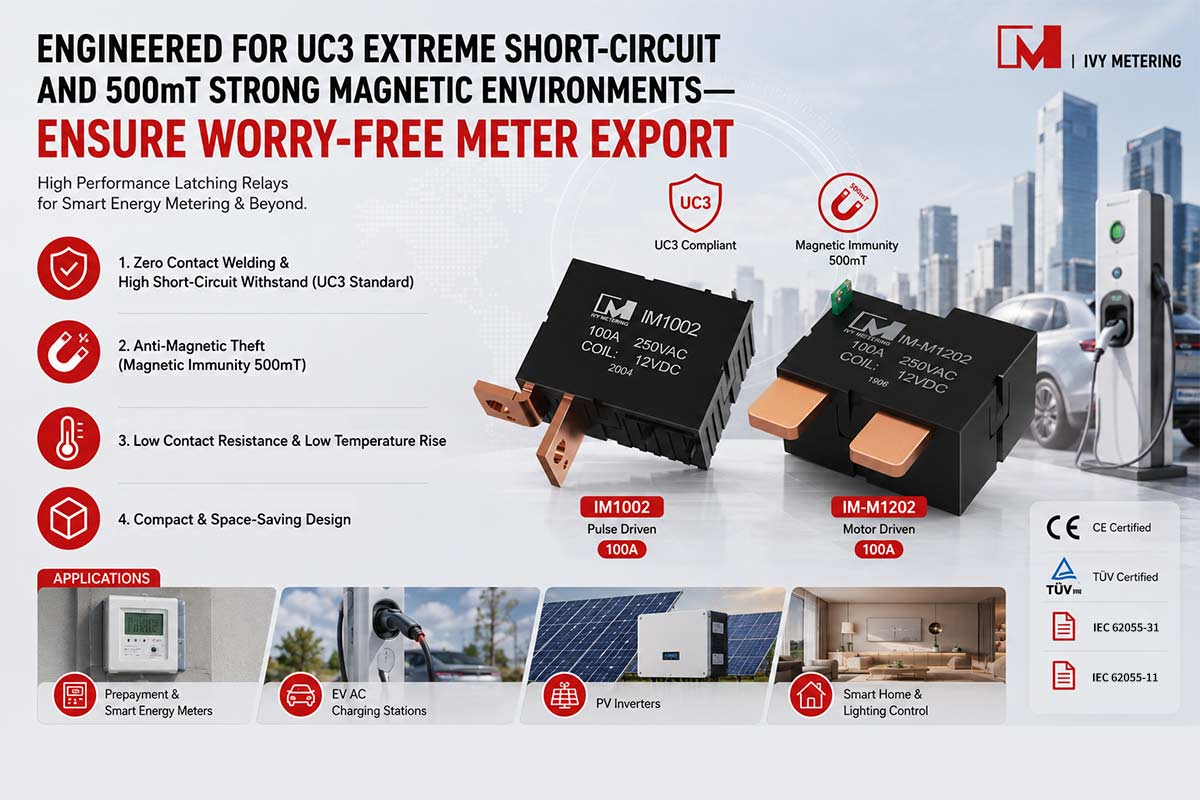
High-quality latching relays must pass stringent international standard tests (such as IEC62055-31 UC2/UC3 compliants) to ensure that the contacts can still disconnect normally after withstanding short-circuit impacts of up to thousands of amperes. It is the last physical line of defense for protecting homes and the power grid.
Function Four: Strong Resistance to Magnetic Interference, Solving the "Electricity Theft" Problem
In many emerging markets worldwide, "magnetic electricity theft" is a persistent headache for power grid companies. Criminals place powerful rare-earth magnets outside the meter, attempting to interfere with the magnetic field of the internal relay, forcing its contacts to close illegally or causing metering failure.
To address this challenge, IVY Metering developed a latching relay with an ultra-strong magnetic field immunity of up to 500mT, and even launched a motor-driven relay with stronger mechanical locking force, which completely eliminates interference from external strong magnetic fields.
In summary, high-precision smart meters require stable, reliable, and shock-resistant latching relays to perform the final "on/off" operation. From pulse-driven to motor-driven, from ordinary anti-magnetic to 500mT extreme anti-interference, each technological iteration of IVY metering relays has propelled the global Advanced Metering Architecture (AMI) towards greater security and efficiency.
For smart energy meter R&D engineers and power grid tenderers, choosing a high-quality latch relay certified by IEC standards is not only about controlling product quality but also a solemn commitment to the electrical safety of countless households.