

What kind of latching relays are needed for smart meters?
Smart meters require the use of small-sized, magnetic field-immunity relays, primarily to meet the design requirements of limited internal space and prevent illegal electricity theft through external strong magnetic field interference, ensuring metering accuracy and power system security.
Preventing Magnetic Field Interference and Electricity Theft: Smart meters commonly use magnetic latching relays, whose working principle relies on the magnetic force generated by an internal permanent magnet.
Defending against Malicious Interference: Without strong magnetic resistance, criminals can interfere with the relay's magnetic circuit by placing a strong magnet (such as a neodymium iron boron magnet) outside the meter, causing the contacts to unexpectedly open or close, thus achieving the purpose of "stopping the meter" or "undercharging" electricity.
Ensuring Metering Accuracy: Electromagnetic fields generated by high-voltage lines or large transformers in the environment can cause errors in the internal electronic components of the meter. Magnetic field-resistant relays ensure stable switching operations even in complex electromagnetic environments, preventing data acquisition deviations.
Adapting to Compact Space Design: As smart meter functions increase (such as remote communication and real-time monitoring), the number of integrated electronic components increases, making space requirements increasingly stringent.
Optimized Internal Layout: Smaller relays free up more space within the limited meter housing for circuit boards, sampling shunts, and communication modules.
Increased Integration: Smaller component sizes allow meter manufacturers to design lighter, more easily installed DIN rail or embedded meters in densely packed enclosures.
Meeting Industry and International Standards:
Safety and Reliability: Smart meters are often used for trade settlements, requiring extremely high reliability and electromagnetic compatibility (EMC).
Industry standards (such as those for China Southern Power Grid or State Grid tenders) typically specify that relays must be able to operate without malfunctioning in specific strong magnetic environments.
Electrical Lifespan: Miniaturized and high-performance relays need to maintain electrical lifespan under high-current loads while reducing size to meet the demands of frequent switching and long-term operation in modern smart grids.
In summary, in smart meter design, to prevent interference from strong external magnetic fields (such as magnets stealing electricity or malfunctions caused by ambient magnetic fields), magnetic latching relays are typically used, with specific technical approaches selected based on antimagnetic performance requirements:
1. Core Relay Types
Magnetic Latching Relay: This is the most critical component in a smart meter, utilizing permanent magnets to achieve self-holding of the contacts. Its advantages include requiring only a momentary pulse to switch on and off, not losing its state after power failure, energy saving, and low heat generation.
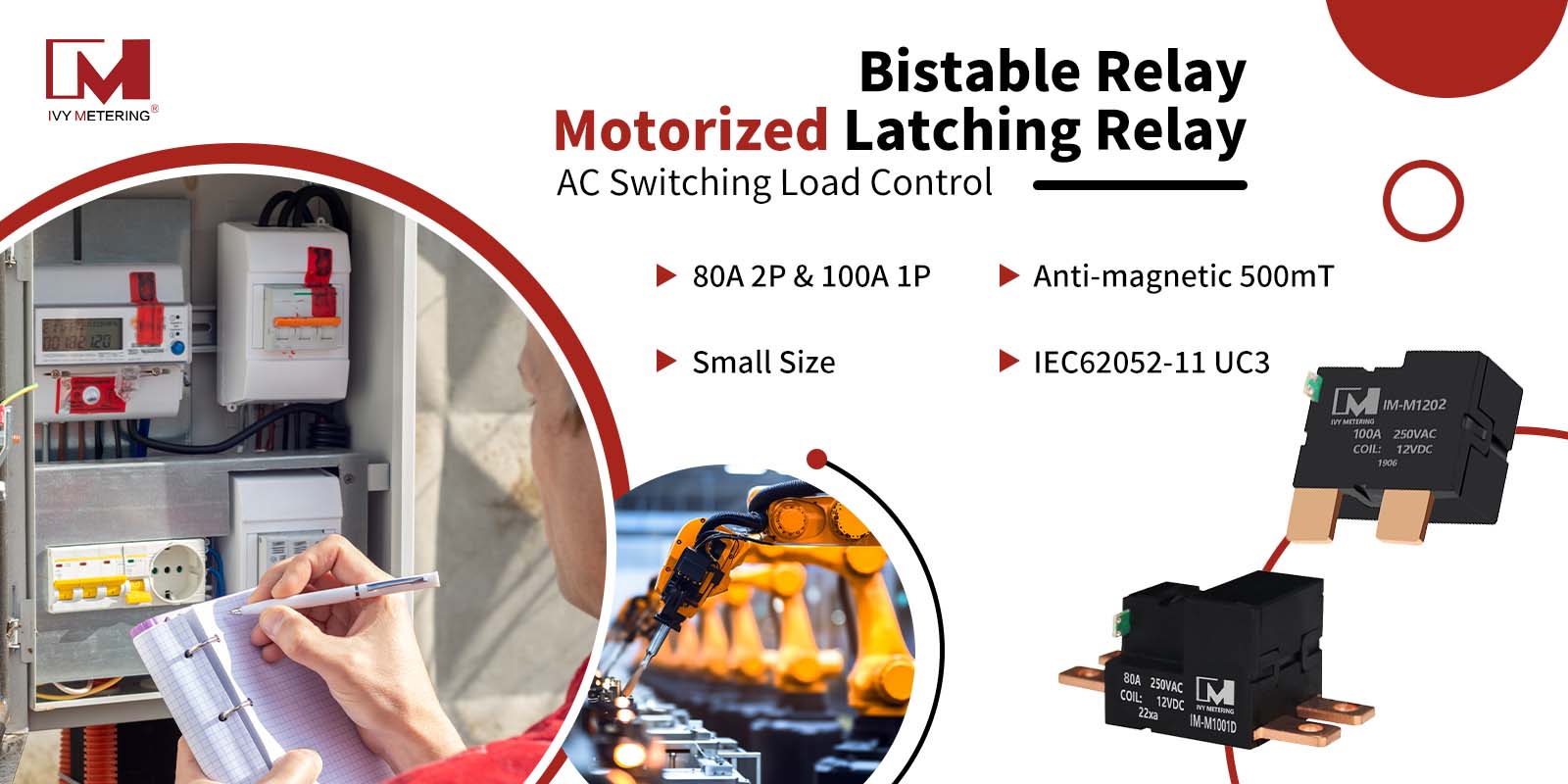
Motorized Latching Relay: To cope with extremely strong magnetic fields (such as 500mT constant magnetic interference), high-end smart meters are now adopting motorized drive structures. Compared to traditional magnetic latching relays, motorized drives are less affected by magnetic field polarity and have stronger anti-interference capabilities.
2. Key Standards and Certifications
IEC 62055-31 IEC 62052-11 Standard: This is the core international standard for evaluating the performance of meter relays.
UC3 Level: This is currently the highest safety level requirement, stipulating that the relay must maintain reliability under strong current surges and complex magnetic field environments.
500mT Antimagnetic Requirement: To prevent magnetic attacks via powerful neodymium iron boron magnets (anti-theft), the relay needs to be able to withstand magnetic fields of 500mT or even higher without tripping falsely or failing to operate.