
EU DC EV Charging Metering Guide: MID Eichrecht OCMF Compliant DC Energy Meter
With the full implementation of the EU’s AFIR, the European EV charging market is facing an unprecedented wave of compliance requirements. The era of billing based on duration or estimated energy consumption is over; any public DC fast charger deployed in Europe must now provide precise, transparent billing based on the actual energy delivered (kWh).
For EVSE OEMs planning to enter the European market, integrating a precise and tamper-proof DC energy meter into their charging stations has become the key to overcoming technical and regulatory barriers. This article provides an in-depth analysis of the three core European DC metering standards—MID, Eichrecht, and OCMF—and offers a practical guide to hardware selection.
1. Why do your DC fast-charging stations require MID and Eichrecht?
Before diving into technical details, we must clarify the two core legal metrology frameworks in Europe:
MID Certification: The "Essential Passport" for Entering the European Market
The MID (Measuring Instruments Directive 2014/32/EU) is a directive applicable across the European Union regarding measuring instruments. For DC charging stations, since AC power is rectified into DC power upon entering the unit, all power losses (such as heat generation and cable losses) occur during the AC-to-DC conversion process.
Consequently, to ensure consumers pay only for the actual energy delivered to the vehicle's battery, regulations mandate that the billing point must be located on the DC side. DC energy meters compliant with MID certification ensure that measurement accuracy remains at Class 1 or higher, even across wide voltage ranges (e.g., 150V–1000V) and under extreme temperatures.
Eichrecht Standard: The "Hell-Level" Barrier for the German Market
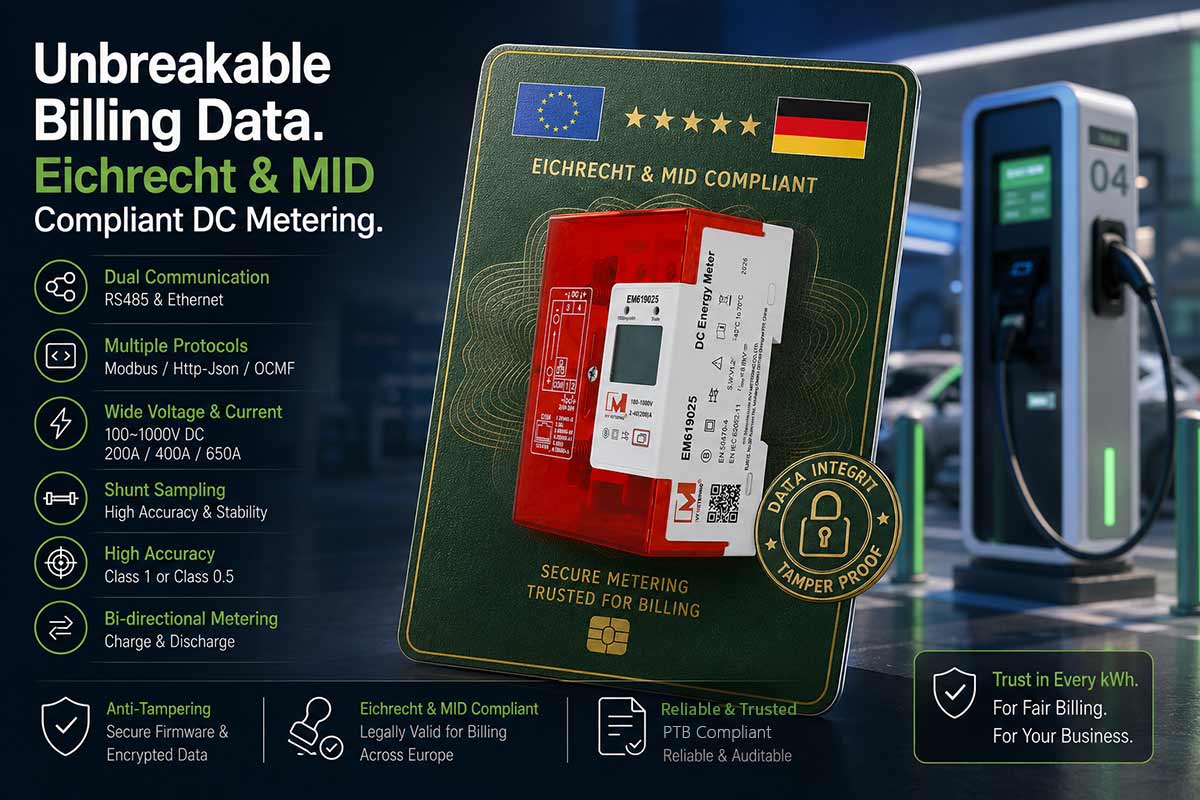
If you wish to enter the German market—Europe's largest and most lucrative—MID certification alone is insufficient. You must also obtain Eichrecht (German Weights and Measures Law) certification, overseen by the Physikalisch-Technische Bundesanstalt (PTB).
The core principle of Eichrecht is"absolute data transparency and tamper-proofing." It demands not only accurate measurement but also guarantees the integrity of data throughout the entire process—from the initial meter reading and transmission to the cloud (CPO backend) to the final display on the vehicle owner's mobile app—ensuring the data cannot be tampered with at any stage.
2. Key to Breaking the Impasse: A Deep Dive into OCMF and Digital Signature Technology
To meet the anti-tampering requirements of *Eichrecht* (German calibration law), the EV charging industry has adopted cryptographic mechanisms. The prevailing solution involves using the OCMF (Open Charge Metering Format) protocol in conjunction with digital signature technology.
How does it work?
When a vehicle owner completes a charging session, the compliant DC energy meter generates a raw data record internally (within its MCU) containing the following information:
Charging station ID and transaction reference number
Start/end times and start/end energy readings (kWh)
Subsequently, a secure chip inside the meter uses a private key to perform a cryptographic operation on this data, generating a unique digital signature (hash-based signature code) and packaging it into an OCMF-formatted message.
Because the private key is permanently embedded within the meter's hardware, it is impossible to forge a valid signed message—even if the charging station's system (e.g., the Linux host) is compromised by hackers. Finally, vehicle owners can verify the authenticity of the billing data with a single click using the official German "transparency software" by simply entering the meter's public key.
3. Avoiding Pitfalls in R&D Selection: How to Choose a DC Energy Meter for Global Markets?
When evaluating and procuring DC energy meters, R&D and procurement teams should focus on three key dimensions beyond mere certification:
True "native" encryption capability: Ensure the meter outputs signed data in OCMF format directly at the hardware level (via RS485/Modbus RTU) rather than relying on external motherboard software for encryption; otherwise, obtaining PTB certification becomes extremely difficult.
Thermal management under extreme heat: In 300kW or even 600kW liquid-cooled supercharging piles, currents can reach 400A–600A. The internal shunt generates significant heat. Superior solutions typically employ a split design—separating the control module from an ultra-low insertion loss shunt—to keep the heat source away from the core control board, thereby eliminating measurement drift caused by high temperatures.
Ease of system integration (Plug & Play): Top-tier hardware suppliers do more than just sell components; they provide comprehensive PC-based debugging software and low-level driver sample code (C/C++), helping customers compress the software integration and debugging cycle from three months down to two weeks.
4. IVY Metering Solution: Eliminating All Compliance Hurdles
To address the three major pain points faced by EV charger manufacturers expanding overseas—long certification cycles, difficult protocol integration/debugging, and severe overheating under high current—we have launched the [EM619025/26/27] series of MID & Eichrecht-certified smart DC energy meters, specifically designed for the high-end European market.
Key Technical Advantages:
Dual Compliance Standards: Hardware architecture fully meets German PTB Eichrecht requirements.
Built-in OCMF Signing Engine: Comes factory-equipped with a unique key pair and native support for OCMF message output; features a standard Modbus-RTU interface for seamless integration with Linux/Android main controllers.
Integrated Shunt Design: Supports continuous high currents up to 1000A and a wide operating voltage range (150V–1000V), making it perfectly compatible with both 400V and 800V high-voltage platform architectures.