

2026 European Smart Grid Anti-Tampering Standards: The Ultimate Relay Selection Guide
As Europe accelerates its transition toward a fully digitized energy grid, utility companies face a significant, often hidden cost challenge: electricity theft. Economic losses resulting from smart meter tampering amount to billions of euros annually.
In response, regulators and major European utilities are significantly tightening requirements. By 2026, newly deployed smart meters must comply with extreme anti-tampering (Magnetic Immunity) and short-circuit withstand capability (UC3).
For smart meter manufacturers (OEMs) looking to win tenders in Europe, upgrading the internal disconnect relay is no longer an option—it's a mandatory requirement. This guide will walk you through the new regulatory landscape and how to select the right relay to future-proof your smart meters.
Why Traditional Relays Are Failing the New European Standards?
Historically, most smart meters used standard Magnetic Latching Relays. These relays rely on an internal permanent magnet to hold the electrical contacts in an open or closed state.
However, energy thieves have discovered a critical vulnerability. By placing a powerful neodymium magnet (often exceeding 400mT) on the outside casing of the meter, the external magnetic field overwhelms the relay's internal magnet. This forces the relay to close unexpectedly, allowing unmetered electricity to flow.
To combat this, the upcoming grid requirements mandate that meters must operate flawlessly even under 500mT external magnetic fields. Traditional magnetic relays simply cannot survive this test.
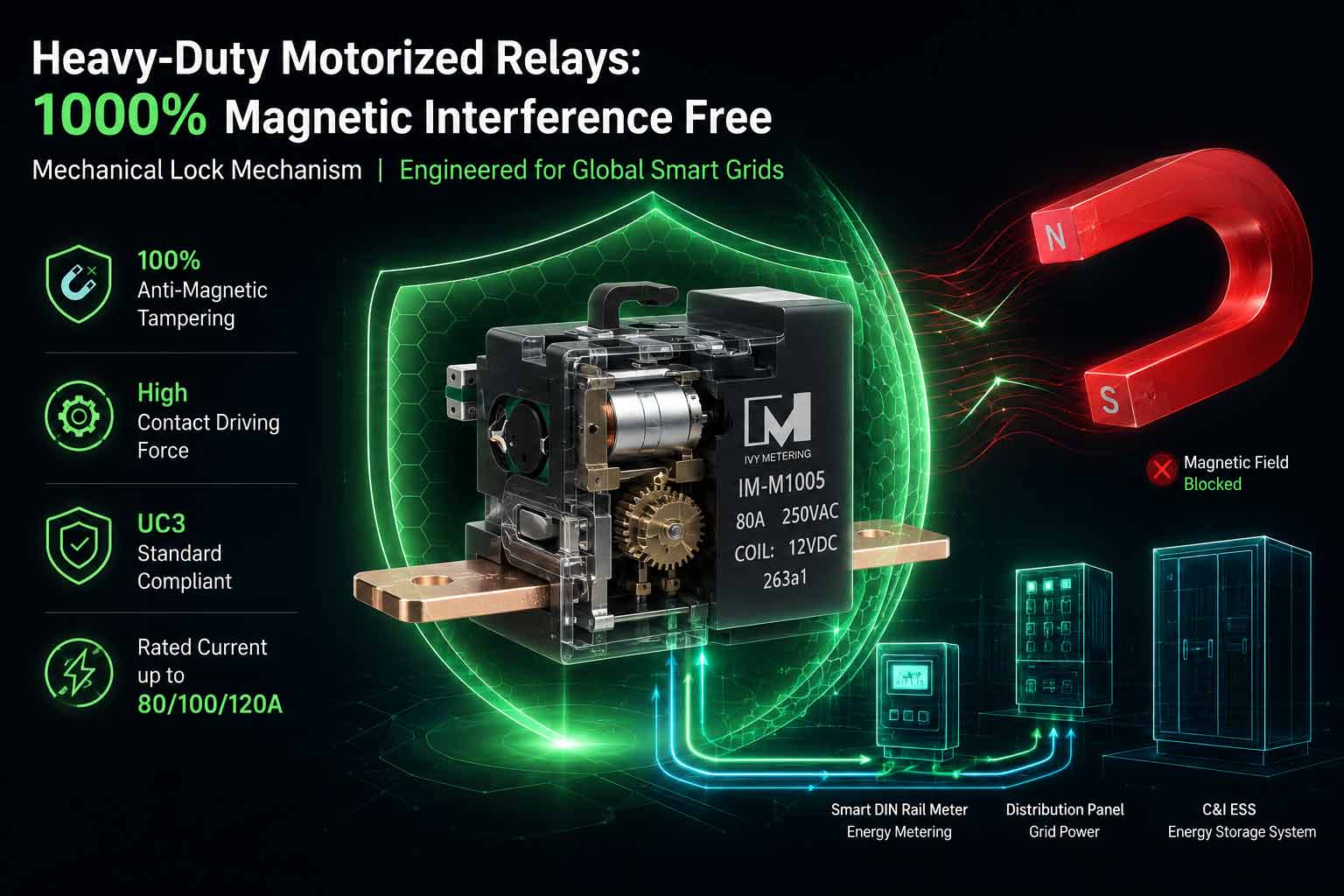
Key Point for Selecting Anti-Tamper Relays in 2026
If you are a hardware architect designing the next generation of European smart meters, your disconnect relay must meet the following three standards:
1. 100% Magnetic Immunity (The Shift to Motor-Driven Relays)
To completely eliminate the risk of magnetic tampering, the industry is shifting away from magnetic latching and moving towards Motorized Latching Relays.
Instead of relying on magnetic pull, these relays use a micro-motor and a mechanical gear system to physically lock the contacts in place. Because the locking mechanism is purely mechanical, no amount of external magnetic force (even up to 500mT) can alter the relay's state.
2. IEC 62055-31 UC3 Short-Circuit Resilience
European grids require meters to withstand massive short-circuit currents without posing a fire hazard. When a 3000A fault current hits, ordinary relay contacts will melt and weld together (Contact Welding).
You must select a relay with a powerful separation mechanism. Motor-driven relays excel here: the geared motor provides immense torque, allowing it to forcefully tear apart slightly welded contacts, effortlessly passing the rigorous UC3 standards.
3. Ultra-Low Temperature Rise at High Loads
European homes are increasing their energy consumption (due to EVs and heat pumps). Relays operating at 80A or 100A must maintain an ultra-low contact resistance (typically <0.5mΩ) to prevent the PCBA from overheating during continuous high-load operations.
The Solution: IVY Metering Motor Latching Relays for the European Market
To help smart meter OEMs seamlessly pass European certifications, we have developed a specialized line of Premium Motor Latching Relays.
Designed explicitly for high-end grid applications, our flagship models—the IM-M1005 (80A) and IM-M1202 (100A)—offer the ultimate defense against tampering and grid surges.
Why Choose Our Motor-Driven Relays?
Zero Magnetic Vulnerability: Pure mechanical gear-locking mechanism ensures 100% immunity to 500mT external magnetic fields.
UC3 Compliant: Engineered to handle devastating short-circuit faults with zero contact welding.
Long Electrical Lifespan: Ultra-low temperature rise protects your smart meter's motherboard, ensuring decades of reliable field operation.
Compact Size: Designed with industry-standard footprints to minimize PCB redesign efforts.