
EV Charger Current Sensor Selection Guide: RCD vs WiFi Clamp CT
As the global transition to electric vehicles (EVs) accelerates, the design of EV charging stations (wall-mounted EV chargers and IC-CPDs) is becoming increasingly complex. For hardware engineers, selecting the right internal components is no longer just about ensuring the charger functions properly, but also about ensuring absolute electrical safety and enabling smart grid interaction.
Of all the components, the current sensor is the "eye" of the EV charger. However, not all sensors function the same way. Today, we will provide a comprehensive selection guide by comparing two popular sensor technologies—AC/DC residual current sensor (Type B RCD) and WiFi clamp CT current sensor.
Through the lens of IVY Metering’s cutting-edge solutions, we will explore their distinct roles, working principles, and how to choose the right one for your next EV charger project.
1. The Safety Guardian: AC/DC Leakage Current Sensor (Integrated RCD)
Primary Function: Fatal fault prevention and IEC compliance.
When an EV is charging, the onboard charger (OBC) converts AC power to high-voltage DC power. If the battery's insulation degrades, smooth DC can leak back into the AC grid. This "DC leakage" can magnetically saturate and blind standard household Type A RCDs, creating a lethal electrocution hazard.
To prevent this, global standards like IEC 62955 and IEC 62752 mandate that EV chargers must detect and instantly disconnect if a 6mA DC or 30mA AC leakage occurs.
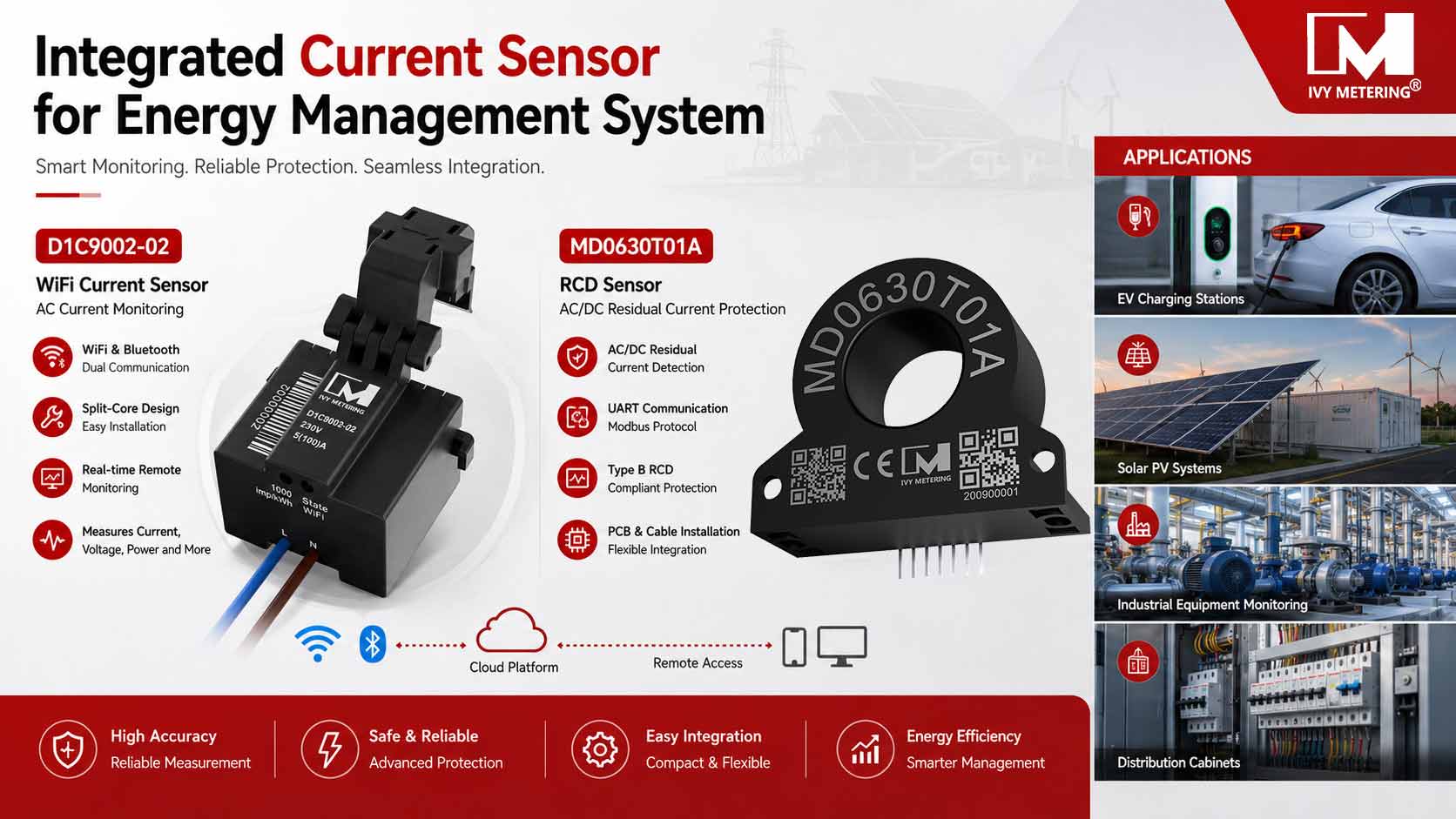
The IVY Solution: MD0630T01A RCD Module
For engineers looking to integrate safety directly onto the PCBA without relying on bulky external Type B circuit breakers, the IVY Metering MD0630T01A is the industry standard.
Key Technical Highlights:
Leakage Detection: Accurately detects both AC (30mA) and smooth DC (6mA) residual currents.
Smart Communication: Unlike simple on/off relays, the MD0630T01A features UART and Modbus communication, sending digital leakage data directly to the charger's main MCU.
Ultra-Compact Design: Designed for direct PCB mounting, saving critical space inside the Wallbox or portable charger.
2. The Smart Energy Manager: Wireless Clamp CT Wifi Current Sensor
Primary Function: Dynamic Load Balancing (DLB) and real-time energy monitoring.
While safety is handled by the RCD, managing the amount of power the EV draws is a different challenge. Charging an EV consumes massive amounts of electricity. If the EV charger operates at full capacity while other heavy household appliances (like HVACs or ovens) are running, the main circuit breaker will trip.
This is where Dynamic Load Balancing (DLB) comes in. The charger needs to know the total power consumption of the house in real-time to adjust the charging current dynamically.
The IVY Solution: D1C9002-02 WiFi Split-Core AC Current Sensor
To monitor the entire household's energy without complex rewiring, the IVY Metering D1C9002-02 split-core current transformer is the ultimate retrofit solution.
Key Technical Highlights:
Wireless IoT Connectivity: Equipped with built-in WiFi & Bluetooth communication, it eliminates the need for long RS485 communication wires between the household breaker box and the EV charger in the garage.
Real-Time Data Transmission: Continuously sends real-time amperage data to the cloud or the EV charger's app, enabling seamless DLB algorithms.
3. Selection Guide: Which One Do You Need?
A common misconception is that these two sensors compete with each other. In reality, they serve entirely different purposes and are often used together in high-end smart charging ecosystems.
Feature IVY MD0630T01A(RCD) Vs IVY D1C9002-02 (WiFi Clamp CT)
Primary Role: Electrical Safety & Leakage Protection and Energy Monitoring & Load Balancing (DLB)
Measurement Target: Micro Leakage Currents (mA) and Heavy Load Currents (Amps)
Installation Location: Integrated inside the EV Charger PCBA and Clamped on the Main Household Breaker
Data Output: UART / Modbus (Wired to MCU) and WiFi / IoT Cloud (Wireless)
The Engineer's Takeaway:
If you are designing the internal circuitry of an EV charger and need to pass safety certifications (CE/TUV), you must integrate the MD0630T01A.
If you are offering a smart home charging ecosystem and want to sell your charger with a premium Dynamic Load Balancing feature, bundle it with the D1C9002-02.
Accelerate Your EV Charger Design with IVY Metering
At IVY Metering, we provide the core sensing components that make modern EV charging safe, smart, and efficient. Whether you need board-level leakage protection or wireless energy monitoring, our field-proven solutions drastically reduce your R&D time and BOM costs.
Stop guessing with your sensor selection. Let our engineering team help you optimize your next Wallbox or IC-CPD design.